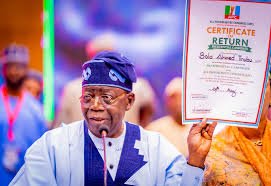
President Bola Tinubu has emerged as the presidential candidate of the All Progressives Congress ahead of the 2027 general election after recording a landslide victory in the party’s nationwide direct primaries.
Official results released by the APC showed Tinubu polled more than 10.9 million votes to defeat Edo-born businessman Stanley Osifo, who secured 16,504 votes across the federation.
The exercise, conducted in 8,809 wards nationwide, marked the first time the ruling party adopted the direct primary model for its presidential nomination process.
READ ALSO



Speaking in Abuja after receiving his Certificate of Return on Sunday, Tinubu extended what he described as a “hand of partnership” to critics and political opponents, urging Nigerians to prioritise national unity ahead of the next election cycle.
“To those who may disagree with us politically, we extend a hand of partnership in nation-building,” the president said.
“Democracy is sustained not by uniformity but by diversity, by a shared belief in the nation and the blending of ideas.”
Tinubu also defended the economic reforms introduced since he assumed office in May 2023, insisting that difficult decisions taken by his administration were necessary to stabilise the economy and reposition Nigeria for long-term growth.
The president highlighted the removal of fuel subsidy, reforms in the foreign exchange market, increased revenue generation, power sector interventions, and infrastructure projects as some of the key achievements of his administration.
He disclosed that the Nigerian Education Loan Fund had disbursed over N282 billion to more than 1.5 million beneficiaries, while the Presidential Metering Initiative had supplied about 2.5 million electricity meters nationwide.
Tinubu also vowed to intensify efforts against insecurity, saying his government would continue investing in intelligence, surveillance systems, and modern equipment for security agencies.
“We will not rest until we restore peace and stability to every corner of our country,” he said, while backing calls for constitutional amendments to allow state police.
Reacting to the outcome of the primaries, Lagos State Governor Babajide Sanwo-Olu described Tinubu’s victory as a reflection of the confidence party members still repose in his leadership.
In a statement issued by his Special Adviser on Media and Publicity, Gboyega Akosile, Sanwo-Olu said the direct primary system adopted by the APC strengthened internal democracy by giving members greater participation in the candidate selection process.
“This victory reflects the confidence and trust that party members across the country continue to place in his leadership and his commitment to building a better Nigeria,” the governor said.
He also commended the APC National Working Committee and state executives for what he called a peaceful and well-organised exercise.
APC National Chairman Netawe Yilwatda described the turnout during the primaries as a “mock demonstration” of what the party expects in the 2027 general election.
According to him, the large participation across states showed that the APC remained the dominant political force in the country despite disagreements witnessed during some governorship and legislative primaries.
The party leadership also dismissed viral videos circulating online alleging manipulation during vote counting, insisting that many of the clips being shared were unrelated to APC activities.
Statistics released by the party showed that over 12.6 million APC members were registered for the exercise, while more than 11 million members were accredited to vote.
Tinubu recorded overwhelming victories across several states, including Lagos, Kano, Kaduna, Rivers, Delta, Enugu, Katsina and Imo, consolidating his hold on the ruling party ahead of what is expected to be a fiercely contested 2027 election.
Political observers say the APC primary victory further positions Tinubu as the party’s undisputed leader going into the next electoral cycle, even as opposition parties continue consultations over possible alliances and coalition talks ahead of 2027.