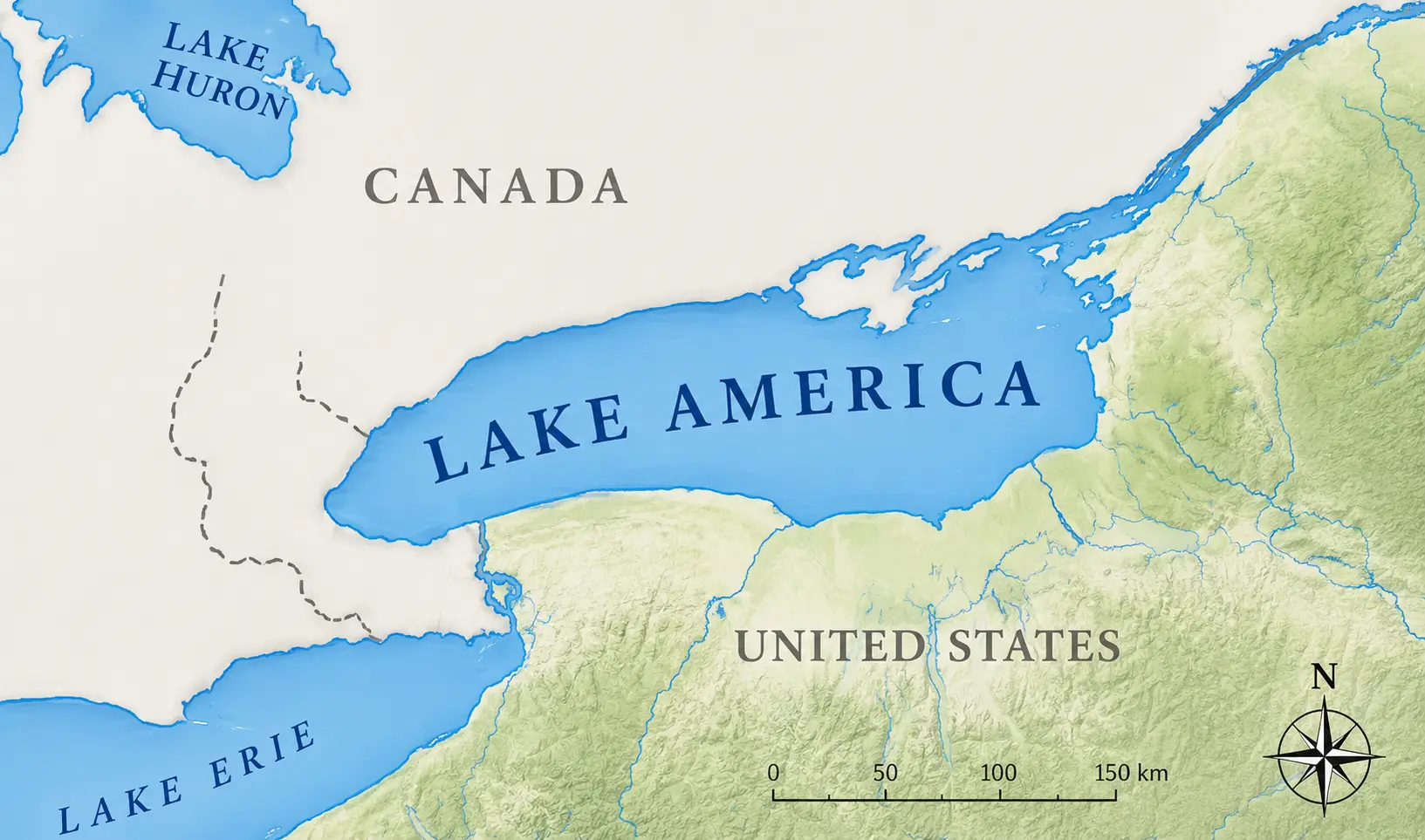
Google Maps has begun displaying “Lake America” instead of Lake Ontario for users in the United States, following President Donald Trump’s executive order renaming the cross-border Great Lake.
The change means users in the US will now see Lake America on Google Maps, while Canadians will continue to see Lake Ontario. Users outside the United States and Canada will see both names, according to Google.
The tech giant announced the update on Saturday, saying it had changed the map in line with the US Geographic Names Information System, the federal database for official geographic names.





“Since we update Google Maps to reflect name changes in official government sources, which is GNIS for the US, people using Maps in the US will see ‘Lake America,’ those in Canada will continue to see ‘Lake Ontario,’ and those outside of the US and Canada will see both names,” Google said.
The update follows Trump’s August 27 executive order directing US authorities to rename Lake Ontario as Lake America and update federal records accordingly.
Lake Ontario is the smallest by surface area of the five Great Lakes and lies along the border between Canada’s Ontario province and New York State.
The renaming has triggered a sharp reaction from Canadian political leaders, who have rejected the American designation.
Canadian Prime Minister Mark Carney said the name Lake Ontario has been used for more than 400 years and originates from the Wendat word “Ontari’io.”
Carney said Canadians would continue to recognise the body of water as Lake Ontario “then, now and always.”
Ontario Premier Doug Ford also criticised the move, describing it as “absolutely backwards” during an appearance on ABC’s This Week on Sunday.
Ford said the name change would not alter the way Canadians identify the lake.
“It was like something out of Saturday Night Live when he signed documents saying change it to Lake America,” Ford said.
“No one’s going to call it Lake of America. It’s been Lake Ontario for hundreds of years. It’s going to continue being Lake Ontario.”
The dispute comes at a particularly tense moment in US-Canada relations, with trade negotiations having broken down and both countries imposing retaliatory tariffs.
Ford warned that the continuing trade confrontation could hurt both sides, particularly because the US and Canadian automobile industries are heavily interconnected.
“A tariff on Canada is nothing more than a tax on American people,” he said, arguing that reduced Canadian purchases of US vehicles could put further pressure on American auto factories.
The Lake America controversy has also produced different responses from competing mapping platforms.
Google Maps has adopted the new designation for US users, while Apple Maps has continued to display Lake Ontario. MapQuest has also rejected the renaming.
The latest development echoes Trump’s earlier decision to rename the Gulf of Mexico as the Gulf of America, another move that generated opposition from Mexico and debate over the authority of unilateral geographic renaming.
For Google, the Lake America update is primarily a reflection of the US government’s official geographic database. For Canada, however, the issue carries a wider historical and political significance.
The lake’s original name remains in use in Canada, meaning the same body of water will now appear under different names depending on where a person accesses a digital map.
The disagreement has consequently become another public symbol of the increasingly strained relationship between Washington and Ottawa.