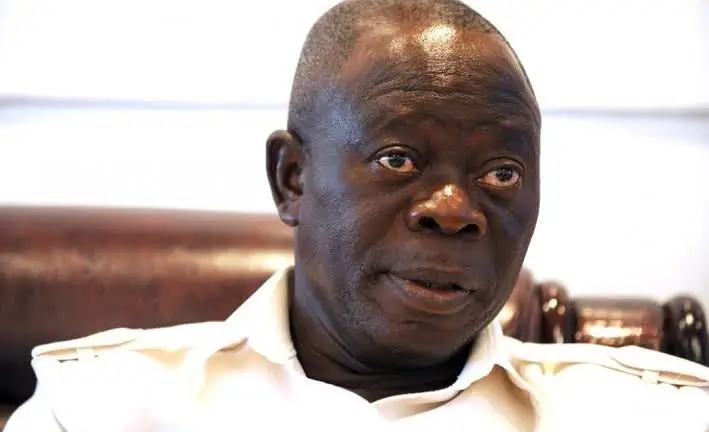
Senator Adams Oshiomhole has recounted how an Italian ambassador allegedly told him that Italian men could not resist Edo women, as he called for Nigeria and Italy to jointly tackle human trafficking.
Oshiomhole made the disclosure during Senate plenary on Tuesday while discussing the need to address both the demand for and supply of victims of human trafficking. A video of the exchange surfaced online on Thursday.
The former Edo State governor said he had met with the Speaker of the Italian Parliament, who promised technical assistance to Edo State to address the supply side of trafficking.



However, Oshiomhole argued that the Italian government should also take steps to discourage its citizens from patronising trafficked women, insisting that the responsibility for combating the crime should not rest solely on Nigerian communities.
Recounting his conversation with the Italian ambassador, the senator said he urged the diplomat to address demand in Italy while Nigerian authorities worked to tackle recruitment and trafficking networks.

According to Oshiomhole, the ambassador replied, “Your Excellency, I’m sorry, Italian people cannot resist Edo girls.”
The senator said he challenged the explanation, arguing that Italian men needed reorientation rather than placing the burden of tackling trafficking entirely on Edo State and other Nigerian communities.
“If they cannot resist, they need the reorientation. Let them deal with Italian people and not Edo people,” Oshiomhole said.
He maintained that Edo and Akwa Ibom states could make progress in addressing the recruitment and supply of victims if destination countries also took meaningful action against the demand that sustains trafficking networks.
Oshiomhole further called for action against organised groups operating abroad that facilitate the trafficking of Nigerian women, warning against a response that places responsibility exclusively on the communities from which victims originate.
The discussion took a lighter turn when Senate President Godswill Akpabio asked Oshiomhole whether he had tried to find out what Italians found appealing about Edo women.
“Seriously, just for the benefit of my colleagues, did you try to find out what the Italians found in the Edo girls?” Akpabio asked.
Oshiomhole replied that he had not investigated the matter because he was “a Catholic and happily married.”
Beyond the exchange, the Senate has called for stronger enforcement of anti-trafficking laws, investigations into suspected trafficking networks and better rehabilitation for victims returning to Nigeria.
Lawmakers have also urged relevant agencies to investigate travel agencies suspected of involvement in trafficking and exploitation, including by examining recruitment channels, financial transactions and travel arrangements.
The Senate has called for stronger enforcement of the Trafficking in Persons (Prohibition) Enforcement and Administration Act, 2015, and the Child Rights Act, 2003, alongside improved protection and reintegration programmes for survivors.
Human trafficking often involves criminal networks operating across several jurisdictions. Efforts to combat it therefore require cooperation between countries of origin and destination, effective investigations and prosecutions, and support for victims.
The alleged remark recounted by Oshiomhole has not been independently established as an official position of the Italian government. The wider debate, however, has renewed attention to the need for coordinated action against those who recruit, transport and exploit vulnerable people.