



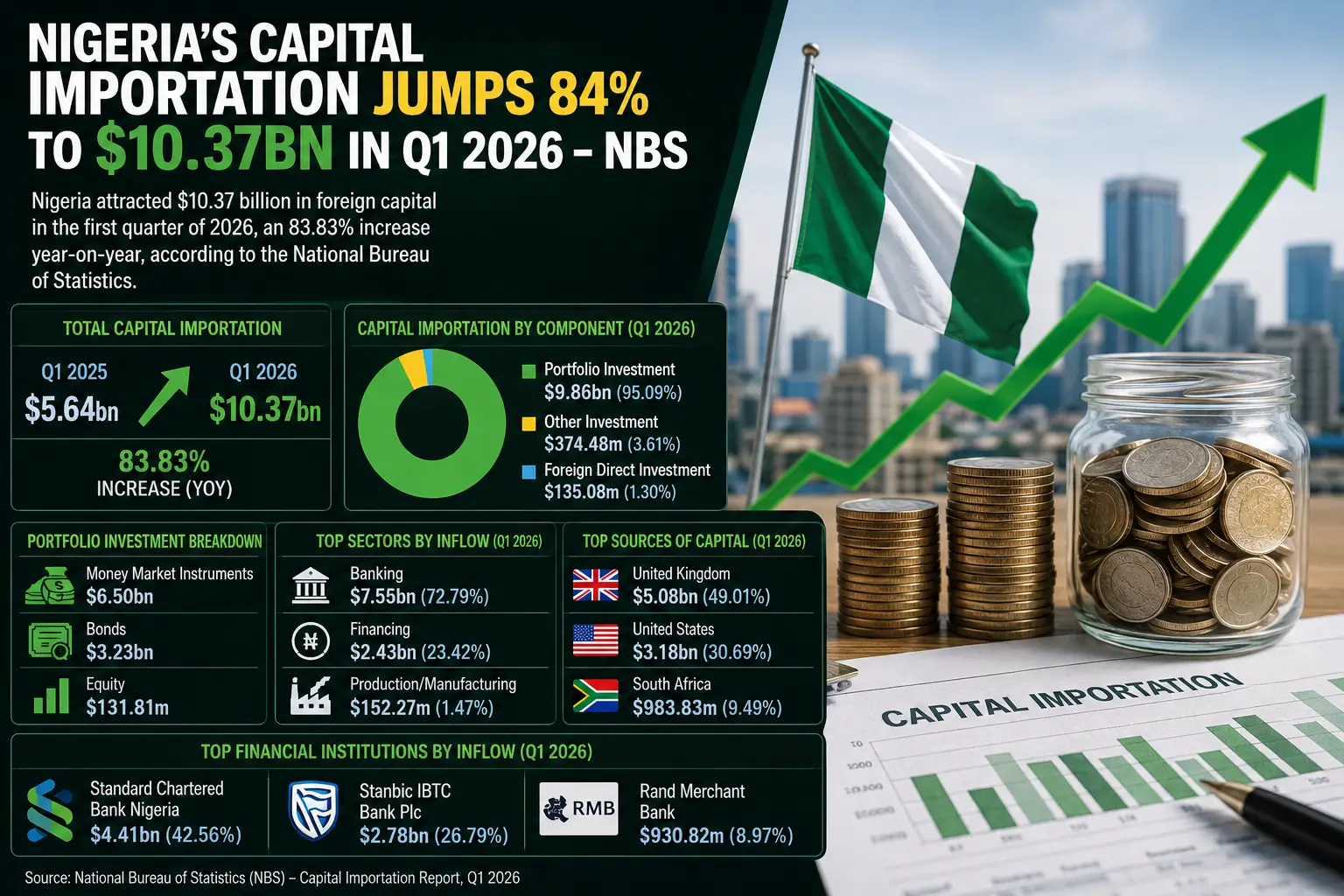
Nigeria’s capital importation surged to $10.37 billion in the first quarter of 2026, marking one of the strongest quarterly foreign capital inflows in recent years as investors increased exposure to the country’s financial markets.
Data released by the National Bureau of Statistics on Wednesday showed that total capital imported into the economy rose by 83.83 percent from the $5.64 billion recorded in the corresponding period of 2025. The figure also represents a 60.97 percent increase from the $6.44 billion reported in the fourth quarter of 2025.
The latest figures point to renewed investor appetite for Nigerian financial assets, particularly fixed-income instruments, amid improving market conditions and sustained interest in high-yield securities.




Portfolio investment remained the dominant driver of inflows, contributing $9.86 billion, or 95.09 percent of the total capital imported during the quarter.
Foreign Direct Investment accounted for only $135.08 million, representing 1.30 percent of total inflows, while other investments stood at $374.48 million, or 3.61 percent.
A breakdown of portfolio inflows showed that money market instruments attracted $6.50 billion, making them the most preferred asset class among foreign investors. Investments in bonds reached $3.23 billion, while equity investments amounted to $131.81 million.
The banking sector emerged as the biggest destination for foreign capital, attracting $7.55 billion, equivalent to 72.79 percent of total inflows during the quarter.
The financing sector followed with $2.43 billion, while production and manufacturing received $152.27 million.
Other sectors that attracted foreign investment included agriculture, information technology services, telecommunications, oil and gas, healthcare, construction, education, transport, consultancy services, and trading.
The United Kingdom remained Nigeria’s largest source of foreign capital, accounting for $5.08 billion, or 49.01 percent of total inflows. The United States contributed $3.18 billion, while South Africa accounted for $983.83 million.
Among financial institutions, Standard Chartered Bank Nigeria handled the highest volume of capital importation, receiving $4.41 billion, or 42.56 percent of the total. Stanbic IBTC followed with $2.78 billion, while Rand Merchant Bank processed $930.82 million.
Other banks that facilitated capital inflows during the quarter included Citibank Nigeria, Access Bank, First Bank of Nigeria, Guaranty Trust Bank, Zenith Bank, FCMB, Ecobank, Fidelity Bank, and United Bank for Africa.

The NBS said the data was compiled from information supplied by the Central Bank of Nigeria and commercial banks reporting fresh foreign capital brought into the country. It added that the figures do not include certain components of foreign direct investment, such as reinvested earnings.
The report highlights a continuing trend in Nigeria’s investment landscape, where foreign investors are increasingly favoring bonds and money market instruments over long-term investments, despite the sharp rise in overall capital inflows.