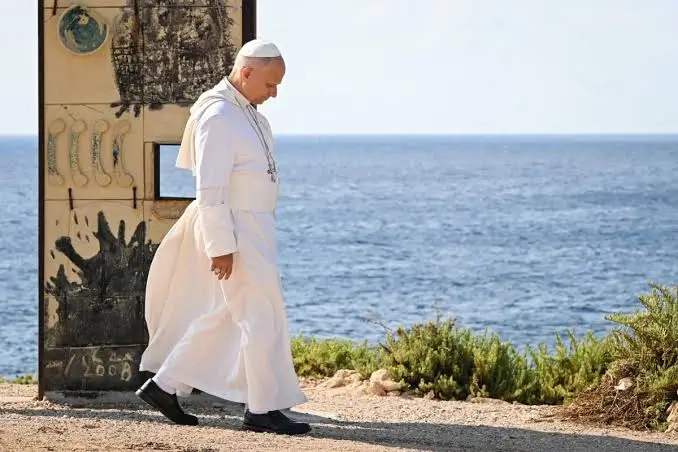
Pope Leo XIV on Saturday visited the Italian island of Lampedusa, one of Europe’s most important migrant entry points, using the trip to renew calls for compassion, safe migration routes and greater international responsibility toward displaced people.
The visit by the Catholic Church’s first American pope came amid renewed debates over migration policies in Europe and the United States, as governments continue to tighten border controls and expand deportation measures.
Pope Leo began his visit at a cemetery where unidentified migrants who died attempting the perilous Mediterranean crossing are buried in numbered graves. He paused in prayer before proceeding to the “Door of Europe”, a monument dedicated to migrants who have lost their lives at sea.
READ ALSO




The pontiff also met briefly with a migrant family during the visit, underscoring what has become one of the defining themes of his papacy: the defence of migrants and refugees.
Observers viewed the timing of the visit as significant, coming just weeks after the European Union approved new migration regulations that broaden detention powers and permit the establishment of deportation centres outside the bloc.
It also coincided with celebrations marking the 250th anniversary of the United States, where Pope Leo has openly criticised harsh immigration policies and mass deportation measures.
The 70-year-old pontiff was expected to use the half-day trip to advocate for safer and legal pathways for migration while calling for policies centred on human dignity rather than deterrence.
His visit was welcomed by humanitarian organisations working along the Mediterranean migration route.
Filippo Ungaro, spokesman for UNHCR, said Leo’s presence carried strong symbolic importance.
“It sends a clear message at a time when the global political debate on migration is often framed around borders and deterrence rather than protection and shared responsibility,” he said.
Lampedusa, located about 145 kilometres from Tunisia’s coast, has long been at the centre of Europe’s migration crisis.
The island, home to roughly 6,000 residents, has become synonymous with both tragedy and solidarity, having received thousands of migrants rescued at sea while also burying many who never completed the journey.
More than 360 people died in a shipwreck off Lampedusa in 2013, one of the deadliest migrant disasters in the Mediterranean in recent decades.
Leo’s itinerary included a stop at the island’s main dock where migrants rescued by coastguards and humanitarian vessels are usually brought ashore.
He was also scheduled to bless a plaque dedicated to the late Pope Francis, who made Lampedusa the destination of his first pastoral trip in 2013 shortly after assuming the papacy.
Last month, Pope Leo visited Spain’s Canary Islands, another migration hotspot, where he condemned human trafficking networks and called for stronger protection of vulnerable migrants.
The Central Mediterranean remains the world’s deadliest migration corridor, according to international migration agencies.
More than 14,000 migrants arrived in Italy during the first six months of the year, with nearly 60 per cent reaching Lampedusa after departing mainly from Libya.
Although arrivals remain significant, they remain well below the levels recorded during the Arab Spring uprisings in 2011, when tens of thousands reached Italian shores within months.