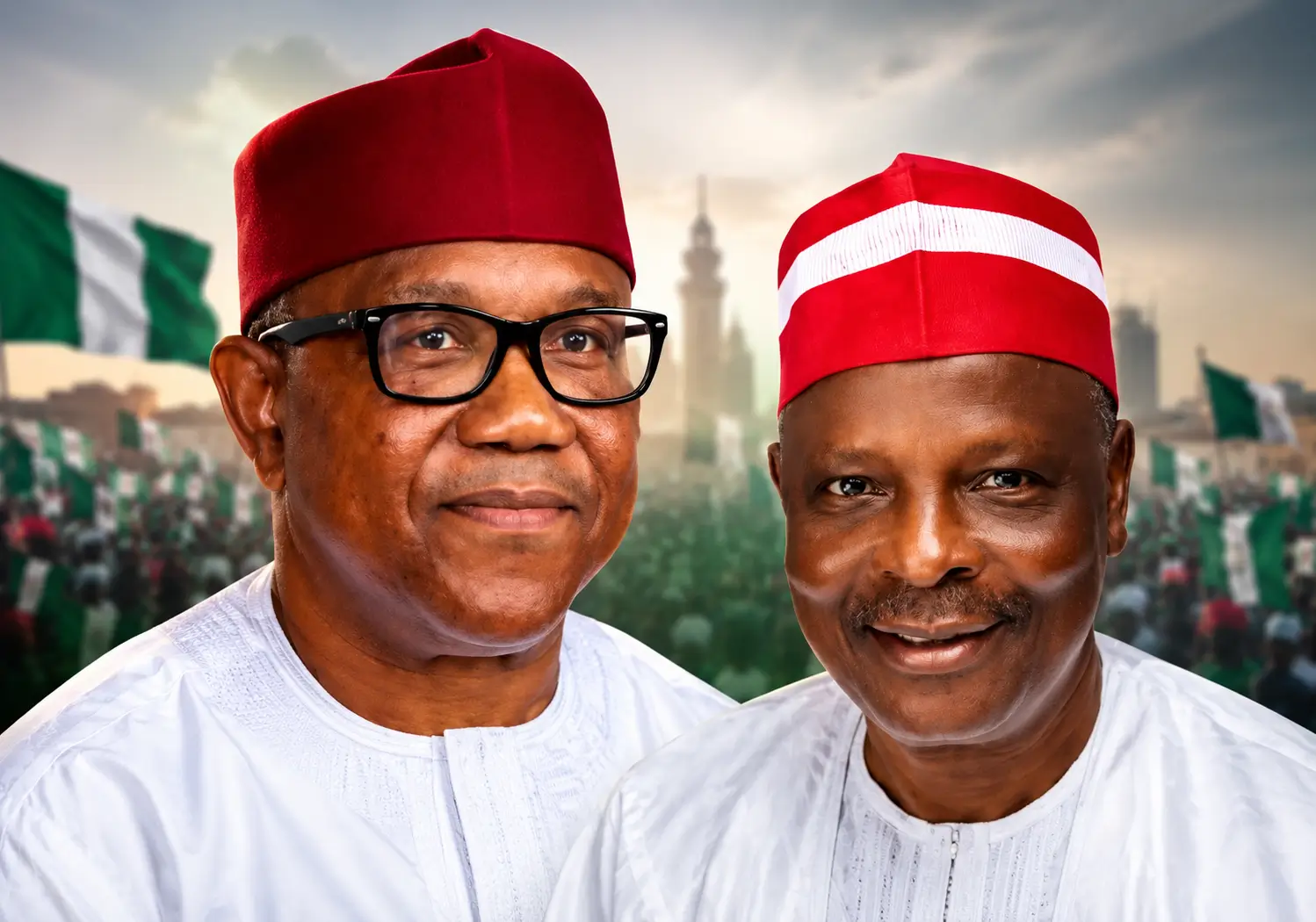
Former Kano State Governor Rabiu Musa Kwankwaso has explained why he agreed to become Peter Obi’s running mate for the 2027 presidential election, saying the decision was driven by national interest, equity, regional balance and the need for political change.
Kwankwaso, the vice-presidential candidate of the Nigeria Democratic Congress, also took aim at former Kano governors Ibrahim Shekarau and Abdullahi Ganduje, as well as incumbent Governor Abba Kabir Yusuf, declaring that the political fortunes of his former allies had declined.
He spoke during a News Agency of Nigeria Personality Interview Series in Abuja, where he reflected extensively on the political realignments ahead of the 2027 election.


Kwankwaso said his relationship with Obi had evolved since the 2023 election, when attempts to forge an alliance between their political camps failed.
He said the experience gave him time to understand Obi better and eventually convinced him that the former Anambra governor was someone he could work with in the national interest.
“People learn every day, and that is why experience is very important,” Kwankwaso said.
The former governor said consultations involving members of the Kwankwasiyya Movement, supporters of the NNPP and the Obidient Movement also influenced the decision.
According to him, the emerging ticket offers a combination of northern and southern political support at a time when Nigeria is battling insecurity, economic hardship, weak agricultural productivity and deteriorating infrastructure.
Kwankwaso has also said that he and Obi agreed that Obi would serve only one four-year term if elected in 2027, after which the presidency would return to the North.
He argued that accepting the vice-presidential position did not amount to a political demotion, despite having served as deputy speaker of the House of Representatives, governor, minister and senator.
“I have never been the vice president. I think it is a step forward,” he said.
Kwankwaso also expressed confidence that Obi would give him meaningful responsibilities rather than treat him as a ceremonial “spare tyre”.
His position echoes Obi’s own explanation that their partnership was based on shared priorities, particularly education, human-capital development and lifting Nigerians out of poverty.
The former Kano governor then turned his attention to the political battles in his home state.
He accused Ganduje of abandoning the political structure they built together after serving as his deputy for eight years before succeeding him as governor in 2015.
Kwankwaso said Ganduje’s political decline began when their relationship broke down, arguing that the former governor would have retained greater influence had he remained within the political structure.
Ganduje has, however, rejected the strength of the Obi-Kwankwaso ticket, arguing that it lacks the political legacy and support required to win Kano in 2027.
Kwankwaso also accused Governor Yusuf of distancing himself from the Kwankwasiyya Movement after the political structure helped propel him to power.
The dispute became significantly more serious in January when Yusuf left the NNPP for the APC alongside several lawmakers, deepening the political rupture between the governor and his former political mentor.
Kwankwaso said Yusuf was now attempting to establish himself as Kano’s dominant political figure, describing the move as politically premature.
Yusuf has also challenged Kwankwaso’s political machinery, insisting that the Kwankwasiyya movement and NNPP would not return to power in Kano.
The confrontation has become one of the major storylines shaping Kano politics ahead of 2027.
With the Obi-Kwankwaso ticket positioned as a major opposition challenge to President Bola Tinubu, the former Kano governor’s latest remarks underline the increasingly intense struggle for political control in Kano and the wider North-West.