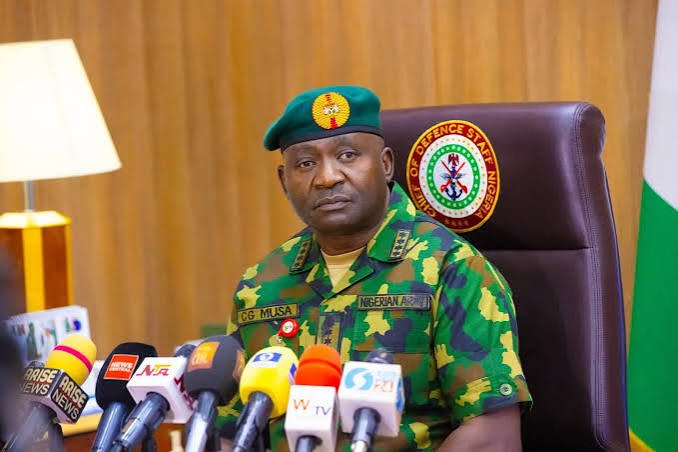
Nigeria’s Defence Minister, Gen. Christopher Musa (retd.), has defended the military’s efforts against terrorism, saying the vast size and difficult terrain of areas used by terrorists continue to make rescue operations and the pursuit of abductors challenging.
Musa spoke on Channels Television’s Politics Today on Thursday, amid renewed concerns over kidnappings and insecurity in parts of the country.
He said security forces were regularly rescuing abducted victims but often faced a familiar problem: by the time information about an abduction reached the authorities, the terrorists had already disappeared into surrounding forests.



The minister used Sambisa Forest to illustrate the scale of the challenge, describing it as being as large as Belgium.
“Sambisa Forest is as big as Belgium, as a country,” Musa said, arguing that public discussions about military operations sometimes made the terrain appear much smaller and easier to secure than it actually was.
The comparison, however, requires some geographical context.
The wider area commonly referred to as Sambisa Forest has historically been estimated at about 60,000 square kilometres, stretching across parts of Nigeria’s North-East. That figure is considerably larger than the officially designated Sambisa Game Reserve, which covers about 518 square kilometres.
Belgium, for comparison, has a total surface area of about 30,690 square kilometres.
The wider 60,000-square-kilometre estimate would therefore make the area described as Sambisa Forest roughly twice the size of Belgium.

Musa’s argument was less about the exact measurement than the operational difficulties created by the terrain.
“These places are massive areas,” he said, explaining that terrorists could move into forested areas before security agencies received information about an abduction.
He said troops sometimes had to track the abductors over long distances while cutting off routes and access to essential supplies before they could rescue victims.
The minister cited a recent operation in Kwara State, saying security forces had to restrict the movement of the abductors and deny them access to supplies before the victims could be recovered.
Musa also explained why some rescue operations end with abducted victims being freed while their captors escape.
According to him, terrorists sometimes abandon their hostages when security forces increase pressure on their positions, making the safe recovery of victims the immediate priority.
He said ransom payments could also provide useful leads for security agencies attempting to identify and track criminal networks. According to the minister, the Central Bank of Nigeria is working to trace funds linked to criminal activities.
Musa’s comments came as he maintained that the country had recorded significant progress against terrorism, with attacks becoming less frequent even though kidnapping remained a serious security concern.
He said the nature of the threat had changed, making the fight increasingly complex for security agencies.
The minister also called on state governors to reconsider distributing motorcycles as palliatives, warning that some of the vehicles could eventually find their way into the hands of terrorists.
He argued that motorcycles could give criminal groups greater mobility, particularly in remote and difficult terrain where conventional security vehicles may struggle to operate.
Musa, a former Chief of Defence Staff, was appointed Minister of Defence in December 2025.
His latest comments highlight the continuing tension between the government’s claim of improved security and the persistent challenge of kidnapping and armed criminal activity across parts of Nigeria.
For the military, the vast and difficult terrain used by criminal groups remains a major operational obstacle. For communities affected by abductions, however, the immediate demand remains the same: faster intelligence, effective rescue operations and the apprehension of those responsible.