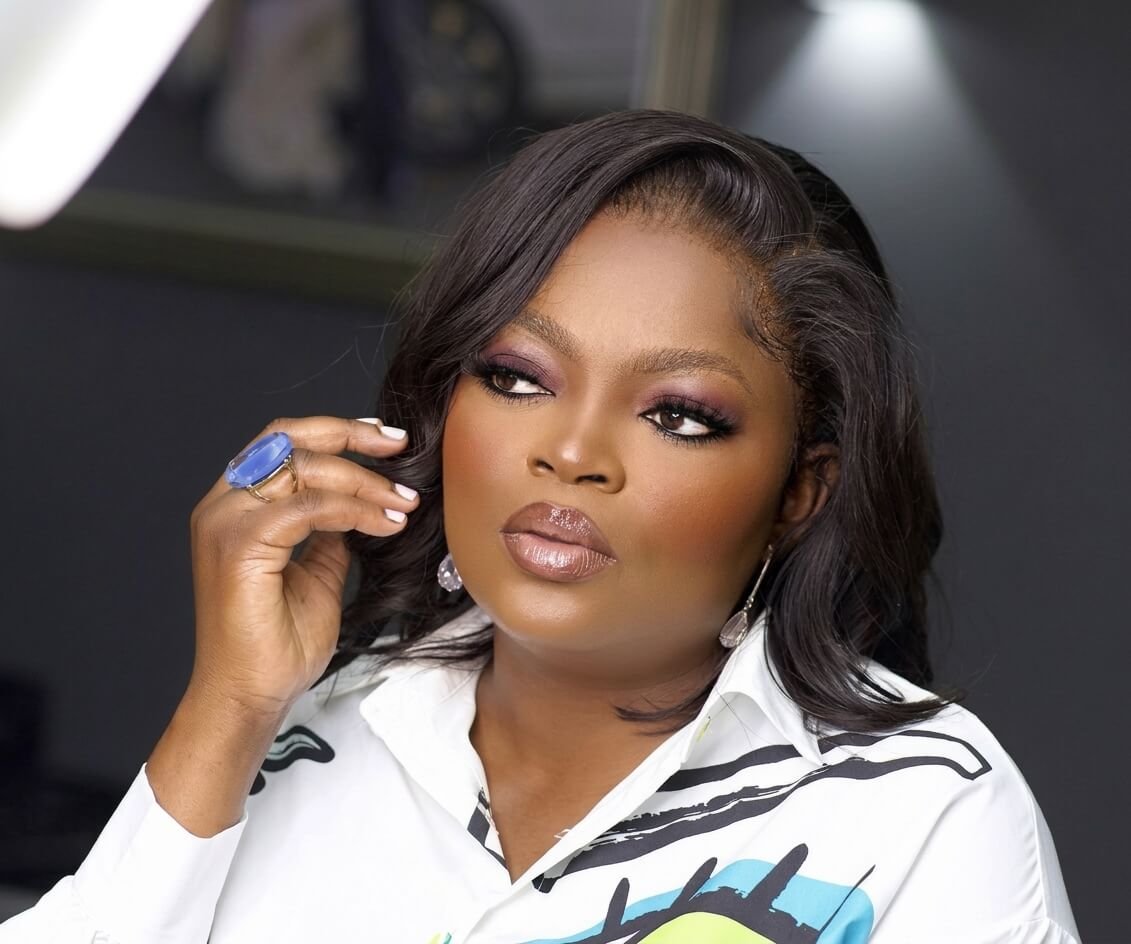
Nollywood actress and filmmaker, Funke Akindele, has revealed that her blockbuster, Everybody Loves Jenifa, was the most expensive film she has produced, attributing the high production costs to international filming, elaborate set construction and logistics involving cast and crew.
The 49-year-old actress disclosed this during an interview with CNN Africa journalist, Larry Madowo, in which she discussed her filmmaking career, the success of the Jenifa franchise, personal challenges and lessons from years of public scrutiny.
Akindele explained that shooting in both Nigeria and Ghana significantly increased the film’s production expenses, particularly the cost of transporting the entire production team to Ghana.



She specifically identified the Safari Valley Resort in Ghana as one of the expensive locations used during filming.
“Everybody Loves Jenifa is a very expensive film because we went to Ghana. We filmed in Ghana and Nigeria. We flew all the cast and crew to Ghana. We filmed in Safari Valley Resort. That is a very expensive place to film,” she said.
The filmmaker also explained that she prefers constructing sets specifically for her productions rather than depending on existing residential properties.
According to her, she either rents or purchases locations before transforming them into suitable filming environments.
“I build my set by myself. I don’t go to people’s houses to shoot. I create my set myself. I would rent out a place, or buy a place and start constructing my set there,” she added.
Despite the substantial expenditure, Akindele said the production performed successfully in cinemas and on streaming platforms. She, however, did not disclose the film’s production budget or the exact revenue generated from streaming services.
Released in Nigerian cinemas on December 13, 2024, Everybody Loves Jenifa became one of Nollywood’s biggest commercial successes, recording approximately N1.88bn in cumulative box-office earnings.
The film, directed by Akindele and Tunde Olaoye, featured Nancy Isime, Stan Nze, Falz, Lateef Adedimeji, Layi Wasabi, Jackie Appiah, Omowunmi Dada and Patience Ozokwor.
Its storyline follows Jenifa as she faces competition from a new neighbour while managing her charitable activities. A visit to Ghana subsequently draws her and her friends into a dangerous encounter involving a drug operation.
The film’s commercial performance further strengthened Akindele’s position as one of Nigeria’s most successful filmmakers.
Beyond discussing production costs, Akindele reflected on the origins of the character that transformed her entertainment career.
She explained that Jenifa was conceived as a village girl determined to become successful in the city despite her limited education and unconventional command of English.
“I sat down and said to myself, let me create a character from the village that is a ‘wannabe’. She wants to be successful. She does not care if her accent is crazy. She wants to speak English,” she said.
The character first appeared in the 2008 Yoruba comedy-drama Jenifa, which introduced audiences to Suliat, a young woman whose ambition to succeed in Lagos frequently resulted in humorous situations.
Akindele subsequently released The Return of Jenifa in 2011 and launched the television series Jenifa’s Diary in 2015.
Her performance in the original film earned her the Best Actress in a Leading Role award at the 2009 Africa Movie Academy Awards.
The actress also described storytelling as a platform for entertaining audiences while addressing social challenges and inspiring younger generations.
“I see storytelling as a tool to show people what is happening in society, address ills and reach out to young people, to help them believe in themselves, because I am very passionate about young people,” she said.
Akindele also opened up about the emotional difficulties of dealing with personal setbacks, particularly the public attention surrounding the breakdown of her marriages.
Her second marriage to Nigerian rapper and filmmaker Abdulrasheed Bello, popularly known as JJC Skillz, ended in separation in 2022 after the couple, who married in 2016, experienced prolonged difficulties. They have twin boys together.
Speaking about the emotional burden of having her private life discussed publicly, the actress said she sometimes withdrew to cry before gathering the strength to continue with her responsibilities.
“When I cry, I lock myself in the room, break down and cry. When I am done crying, I shake myself, wipe off my tears and come back to life,” she said.
She acknowledged that public scrutiny sometimes made her worry about being judged for her personal decisions.
“Sometimes I tell myself, you’ve made a mistake again. People are going to judge you. And really, do you care about that? Brace up, do what is right, consider yourself, your mental health, and move on,” she added.

The filmmaker also said her priorities had changed over the years, particularly her approach to balancing professional commitments with personal happiness.
She explained that she previously concentrated heavily on work but had come to appreciate the importance of taking care of herself.
“Now I am more intentional about myself, making myself happy. I have noticed that over the years, it was not about myself. You need to take care of yourself,” she said.
“In the past, it used to be about work, work. But I have come to realise that work will come and go, but some things stay when the work is gone, and that is factual,” Akindele added.