



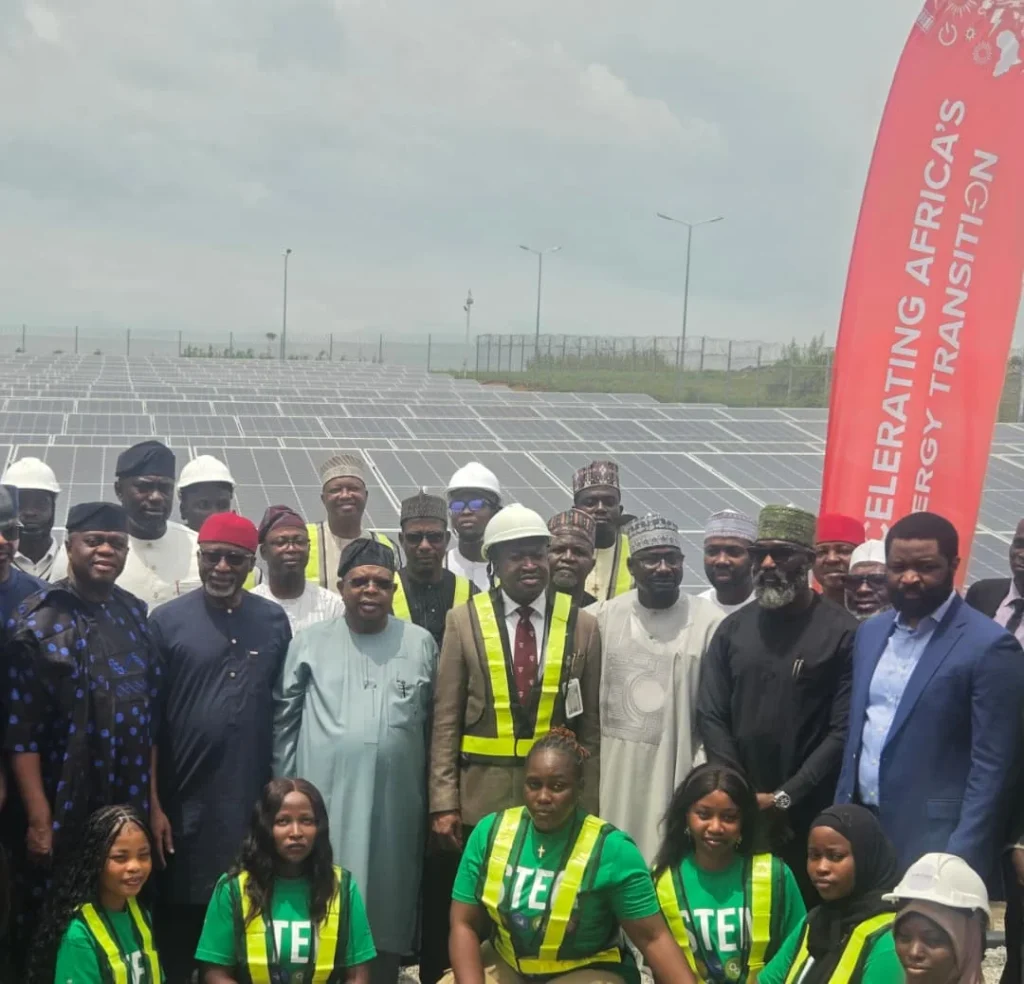
The Federal Government (FG) has commissioned a 3MW solar hybrid power plant at Yakubu Gowon University, Abuja, formerly the University of Abuja, to strengthen electricity supply for teaching, research, laboratories and other critical university operations.
The facility was commissioned on Wednesday by the Minister of Power, Joseph Tegbe, under Phase II of the Energising Education Programme, implemented by the Rural Electrification Agency with support from the World Bank-funded Nigeria Electrification Project.
The project combines a 3.3MW solar array with 3MW of AC output capacity and 2MWh of battery storage, according to details presented at the commissioning.

The battery system is designed to support critical loads beyond solar-generation hours, while the project also includes 388 streetlights to improve illumination and security across the campus.
Tegbe, who described the university as his alma mater, said the project demonstrated how energy investment could be linked to human capital development.
“There is perhaps no better place to demonstrate the practical value of Nigeria’s energy transition than a university,” the minister said.
He said universities required reliable electricity to support learning, research, healthcare, technology, administration and digital infrastructure.
Tegbe also addressed a request by the Student Union Government for electricity from the project to be extended to student hostels and other areas of the institution.
According to him, the government was considering increasing the battery storage capacity to allow the facility to serve more parts of the university.
“Your Vice-Chancellor has come to see me on this, and we’re looking into it. I will make sure that in the next six months, every other area will be covered,” he said.
The minister urged students and staff to protect the infrastructure from vandalism, stressing that renewable-energy facilities represented major public investments.
He said the government was working with security agencies to safeguard national assets, including electricity infrastructure.
Tegbe also said the government was developing systems to ensure renewable-energy facilities remain operational after commissioning.
He linked the sustainability plan to the Renewable Asset Management Company, which is being developed to support the maintenance and management of renewable-energy assets.
The project is also intended to provide an avenue for practical training and research.

The Rural Electrification Agency has previously disclosed that the Yakubu Gowon University project includes a workshop and training facility where students can gain hands-on knowledge of renewable-energy technologies.
REA Managing Director and Chief Executive Officer Abba Aliyu said the Energising Education Programme had delivered renewable-energy infrastructure to 22 federal universities and three affiliated teaching hospitals, with more than 100MW of clean energy deployed.
He urged the university to use the facility as a research platform for renewable energy, battery storage, grid integration, smart metering and energy management.
The EEP Phase II project at Yakubu Gowon University is part of a broader Federal Government effort to improve electricity reliability at public tertiary institutions, where unstable power supply can affect academic activities, laboratories, research and campus security.
The university’s Vice-Chancellor, Professor Hakeem Babatunde Fawehinmi, described the project as a major investment in the institution’s academic mission.
The commissioning adds Yakubu Gowon University to the growing number of Nigerian federal institutions receiving dedicated renewable-energy infrastructure as the government seeks to reduce dependence on conventional electricity supply and improve energy reliability in critical public facilities.