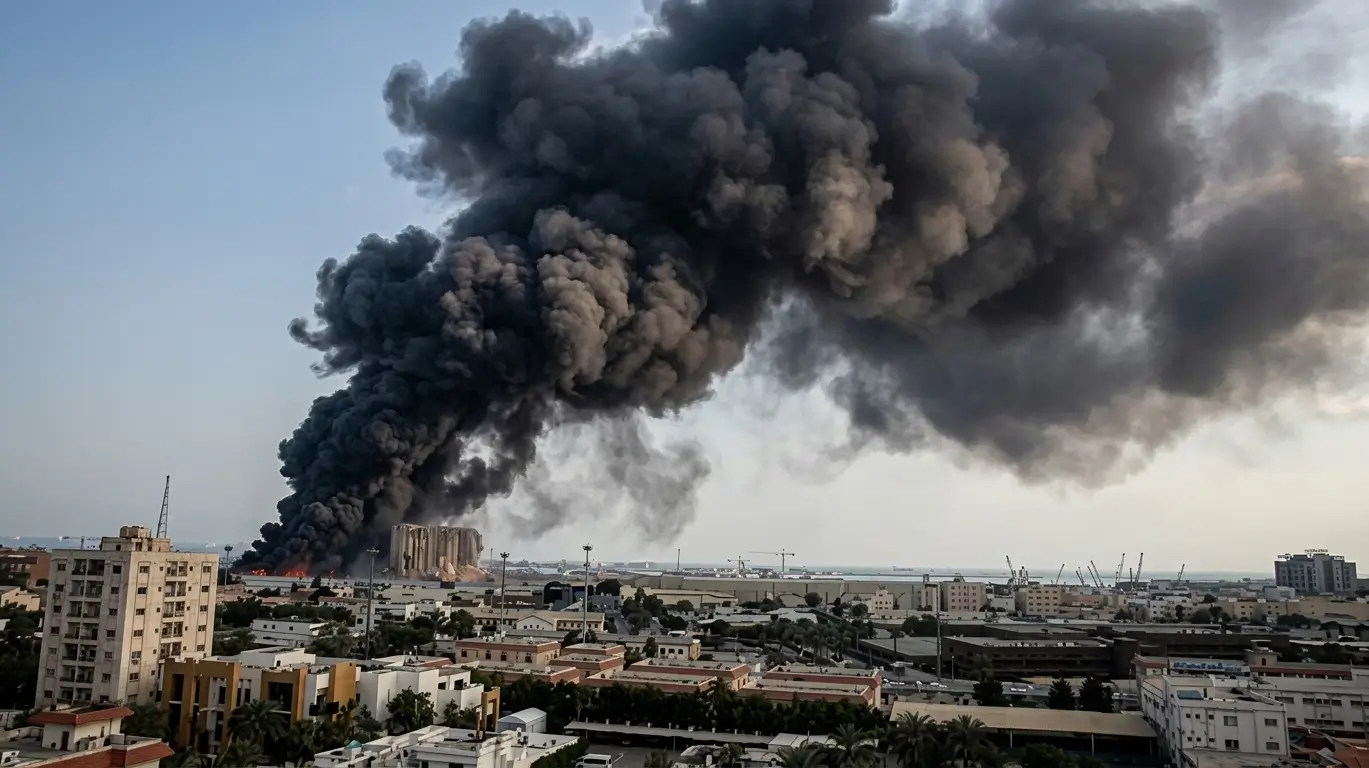
Tensions across the Middle East reached a dangerous breaking point on Monday after Iranian forces launched retaliatory ballistic missile strikes targeting United States military installations in Jordan and the United Arab Emirates. The dramatic escalation marks the first direct military flare-up between Washington and Tehran in over a month, severely threatening global oil routes and regional stability.
Iran’s Islamic Revolutionary Guard Corps (IRGC) claimed responsibility for the assault, reporting via state media that its forces struck two key US military air bases in Washington-allied Jordan, inflicting “heavy damage.” While the Jordanian military confirmed intercepting eight incoming missiles, official military spokespersons stopped short of naming the source of the projectiles. Shortly after, Iranian authorities confirmed launching additional strikes aimed at US military personnel stationed at an air base in the UAE.
The retaliatory barrage followed pre-emptive American airstrikes on Iranian positions on Sunday. US naval forces launched targeted attacks on Larak Island, situated strategically along the narrow Strait of Hormuz—a crucial maritime corridor for global crude oil shipments.




“Earlier today, US forces struck two Iranian launchers on Larak Island. Islamic Revolutionary Guard Corps forces were observed preparing to launch rockets with sea mines into the Strait of Hormuz,” stated US Navy Captain Tim Hawkins. The operation marked the Pentagon’s first direct strike inside Iranian territory since late July.
As military clashes intensify, diplomatic realignments are rapidly unfolding on the global stage. Iranian President Masoud Pezeshkian arrived on Monday to attend the Shanghai Cooperation Organisation (SCO) summit, a regional Eurasian bloc positioning itself as a geopolitical counterbalance to Western influence. Kremlin spokesman Yuri Ushakov confirmed that Russian President Vladimir Putin will host separate high-level bilateral discussions with Pezeshkian and Chinese President Xi Jinping during the summit.
Simultaneously, Washington is intensifying its economic warfare against Tehran. US Treasury Secretary Scott Bessent announced plans to rally G20 finance ministers this week to enforce stricter secondary sanctions aimed at completely choking off Iran’s financial pipelines. Washington warned of severe economic repercussions for foreign nations refusing to comply with the sanctions regime.

The economic crackdown has already triggered immediate financial fallout across the Gulf region. The Central Bank of the United Arab Emirates announced an emergency forensic audit of Egypt’s state-owned Banque Misr branches within the UAE. The intervention came after Washington threatened to sever Banque Misr’s access to the US financial system over alleged illicit transactions linked to Iranian networks.
“For Banque Misr branches in the UAE, the Central Bank has decided to conduct a special and urgent examination that includes a forensic/in-depth lookback covering the period referred to in the statement issued by the US authorities,” the UAE Central Bank stated.
On the ideological front, Iran’s Supreme Leader Mojtaba Khamenei issued a written declaration marking six months since the outbreak of hostilities, urging Muslim nations across the Middle East to form a unified front against the US and Israel. Khamenei, who assumed leadership following the death of his father Ali Khamenei early in the conflict, has notably not made a single public appearance or issued video footage since taking power.