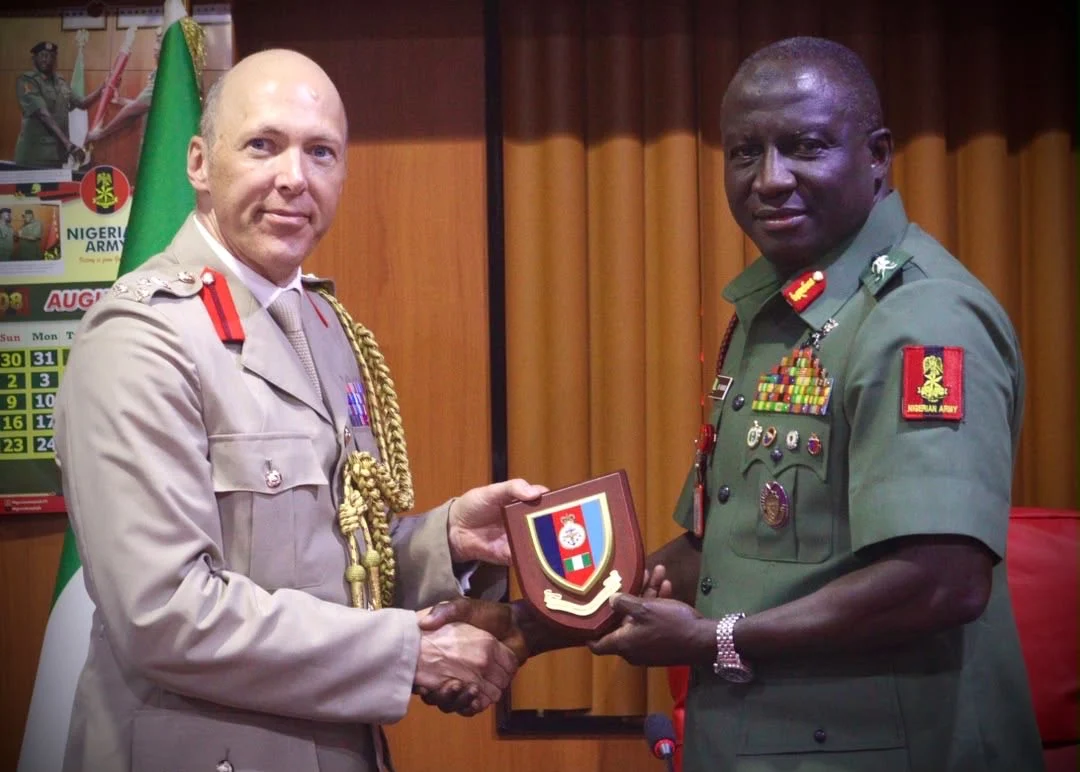
The United Kingdom (UK) has proposed expanding military support for Nigeria to include air defence systems, counter-drone capabilities, enhanced intelligence and a reference forward operating base as London and Abuja deepen their strategic defence partnership.
The proposals were discussed on Tuesday when the British Defence Adviser to Nigeria, Brigadier Tom Harper, met the Chief of Army Staff, Lieutenant General Waidi Shaibu, at Army Headquarters in Abuja.
The proposed support also includes protected mobility vehicles, specialised ammunition and expanded tactical Intelligence, Surveillance and Reconnaissance capabilities to brigade level.




Harper further highlighted plans for the establishment of a reference Forward Operating Base within a cantonment environment as part of efforts to strengthen the Nigerian Army’s operational capacity.
The development comes as Nigeria continues to confront asymmetric security threats, particularly in the North-East, where troops are engaged in sustained counter-insurgency operations.
The British official also disclosed plans to expand regional train-the-trainer programmes covering combat tactical drills, casualty care and advanced patrolling.
Future Operation Hadin Kai training cohorts are expected to include troops from Niger, Cameroon and Chad alongside Nigerian personnel.
The initiative is expected to improve interoperability and strengthen the ability of regional forces to respond collectively to security threats that increasingly cross national borders.
Shaibu said the partnership with the UK was critical to building “a more adaptable, combat-ready and resilient force” capable of responding to evolving threats.
The Army chief identified asymmetric warfare and operations in difficult terrain, particularly in the North-East, as major challenges requiring stronger intelligence, surveillance and reconnaissance, technical intelligence, aviation capability and round-the-clock situational awareness down to battalion level.
He also noted the expansion of the Nigerian Army from eight to 12 divisions, saying the growth would require additional investment in advanced training, instructor development and Special Forces capabilities.
Shaibu specifically identified the Doma training facility as an area requiring enhanced capacity.
He also stressed the importance of sustained cooperation with trusted international partners in capability development, professional military education and technology integration.
The latest engagement builds on the wider Nigeria-UK Security and Defence Partnership, under which both countries have agreed to strengthen cooperation on counter-terrorism, intelligence sharing, defence capability development, cyber threats and regional security.
At their fourth Security and Defence Partnership Dialogue in Abuja in June, the UK reaffirmed its long-term commitment to supporting Nigeria’s armed forces, including efforts to counter uncrewed air systems and improvised explosive devices.
Both countries also agreed to deepen cooperation on regional security and explore opportunities to strengthen defence trade.
The British support comes as drone technology becomes increasingly important to modern warfare, making counter-unmanned aerial systems a growing priority for militaries confronting insurgent and terrorist groups.
For Nigeria, improved air defence, tactical intelligence and persistent surveillance could strengthen the ability of troops to detect threats, protect military positions and improve operational coordination.
The planned regional training programme also gives the partnership a broader West African dimension, particularly as insecurity increasingly spills across national borders.

Shaibu said the Army was committed to institutionalising operational lessons and preserving military knowledge through command curricula and the digitisation of military archives.
The Army said the discussions reflected a broader effort to equip its personnel to anticipate, deter and decisively respond to emerging threats.
The UK-Nigeria partnership also includes cooperation on civilian protection, accountability and human rights, with both countries previously agreeing that sustainable security operations must incorporate non-kinetic approaches.