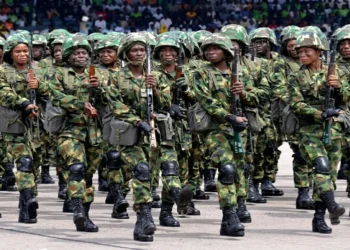




The Oyo State House of Assembly has passed the constitutional amendment bill seeking to establish State Police Services across Nigeria.
The bill, titled the Constitution of the Federal Republic of Nigeria (Sixth Alteration) Bill, 2026, was passed at plenary on Tuesday after clause-by-clause consideration, with Speaker Adebo Ogundoyin presiding.
The development comes less than two weeks after the National Assembly transmitted the State Police constitutional amendment to all 36 state Houses of Assembly for consideration.



The Clerk to the National Assembly, Kamoru Ogunlana, said the bill was transmitted on September 16 in line with Section 9 of the 1999 Constitution, which governs constitutional alterations.
The proposal had earlier cleared the federal legislative hurdles, with the Senate passing the bill on June 24 and the House of Representatives adopting the executive version on July 23, 2026.
Speaking during the plenary, Ogundoyin said the passage would have significant implications for the Oyo Assembly, particularly the need for the legislature to develop a comprehensive law to establish and regulate the proposed State Police Service.
He said the amendment would fundamentally alter Nigeria’s policing architecture by providing for a Federal Police Service alongside State Police Services.
Under the proposed framework, each state would be empowered to establish its own police service through legislation by the State House of Assembly.
State Police Services would be responsible for enforcing state laws, maintaining public safety and order, preventing and detecting offences within their policing jurisdiction, protecting life and property, and performing other local policing functions prescribed by state law.
The bill also provides for State Police Service Commissions to oversee areas including recruitment, promotion, discipline, complaints and accountability of personnel.
A State Police Commander would head each state police service under the proposed structure, with appointment arrangements involving the governor, the National Police Council and the State House of Assembly.
The proposed amendment, however, does not mean the Nigeria Police Force would disappear.

Instead, the framework envisages a dual policing structure in which a Federal Police Service would continue handling federal responsibilities, including matters with national-security, inter-state and international dimensions.
State police would also have to meet nationally prescribed standards before becoming operational.
The constitutional amendment still has hurdles to cross before it can become law. At least 24 of the 36 state Houses of Assembly must approve the proposal, representing the two-thirds threshold required under Section 9 of the Constitution.
The National Assembly had specifically transmitted the State Police proposal to the state legislatures as part of that process.
Oyo’s approval therefore moves the bill another step forward, but does not by itself establish a State Police Service in the state.
The proposal has been at the centre of Nigeria’s long-running debate over the centralised policing structure, with supporters arguing that state-level policing could bring law enforcement closer to communities, while concerns have focused on funding, jurisdiction, accountability and possible political interference.
For Oyo, the next major legislative task would be to determine the framework, funding, oversight and operational structure of any State Police Service if the constitutional amendment eventually takes effect.