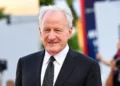
The National Publicity Secretary of the African Democratic Congress, Bolaji Abdullahi, has questioned whether Finance Minister Taiwo Oyedele has the appropriate educational background to oversee Nigeria’s economy, arguing that economic policymaking requires specialised training and a clear understanding of competing economic philosophies.
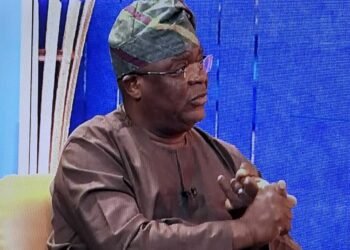
Abdullahi made the remarks on Monday during an interview on Channels Television’s Politics Today, where he discussed the Federal Government’s economic policies, particularly its decision to introduce a 30-day petrol discount at Nigerian National Petroleum Company Limited retail outlets.
Although he acknowledged Oyedele’s intelligence and said he had considerable respect for the minister, the ADC spokesman argued that professional competence in accounting did not necessarily translate into the expertise required to assess an entire economy.
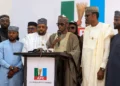



“I’m not saying he’s incompetent, but I think he doesn’t have the right education,” Abdullahi said.
He maintained that decisions concerning fuel subsidies and other economic interventions were not merely technical calculations but were also influenced by ideological positions on how an economy should be managed.
“The issue of subsidy is ideological, and we have to understand where you are coming from,” he said.
Abdullahi further argued that accountants, classical economists and development economists could approach the same economic challenges from different perspectives.
“The way an accountant reviews an economy is not the same way an economist reviews it,” he said, adding that Nigeria needed people specifically trained to handle the responsibilities associated with economic management.
Oyedele, however, has a professional background spanning accounting, taxation and fiscal policy. He obtained a Higher National Diploma in Accountancy and Finance from Yaba College of Technology before proceeding to Oxford Brookes University for a degree in Applied Accounting.
He also completed executive education programmes at institutions including the London School of Economics, Yale University and Harvard Kennedy School.
Before his appointment as Minister of Finance and Coordinating Minister of the Economy, Oyedele chaired the Presidential Committee on Fiscal Policy and Tax Reforms.
He also spent 22 years at PricewaterhouseCoopers, where he rose to become Fiscal Policy Partner and Africa Tax Leader, gaining experience in tax advisory, policy advocacy and related areas.
His professional background has centred on accounting, taxation and fiscal policy, areas that intersect with government revenue, public spending and broader economic management.
Abdullahi’s comments have brought renewed attention to the qualifications and professional experience required for senior economic policymaking positions. However, his assertion that Oyedele lacks the right education remains his assessment of the minister’s suitability for the role.
The criticism comes amid controversy over the Federal Government’s 30-day petrol discount, which Oyedele announced on October 8 as part of efforts to cushion the impact of rising fuel prices.
Under the arrangement, NNPC Retail is foregoing its retail profit margin to sell petrol at a discount for an initial period of 30 days, with public transport operators receiving priority.
The company subsequently confirmed that the discount, which began on October 1, would continue until October 31.

The Federal Government and NNPC have insisted that the measure is a temporary relief initiative rather than a return to the petrol subsidy regime abolished in May 2023.
However, the policy has drawn criticism from opposition figures and political groups, including former Vice-President Atiku Abubakar, the Nigeria Democratic Congress and the presidential campaign organisation of Oyo State Governor Seyi Makinde.
Their objections have focused on the temporary nature of the intervention, its expected impact on household expenses and concerns about the government’s approach to petrol pricing.
Atiku has argued that a short-term discount would not resolve the wider pressures affecting transport fares and food prices, while Makinde’s campaign organisation has questioned the adequacy of the intervention.
The Presidency and NNPC have maintained that the discount is intended to provide temporary relief without reversing the market-based pricing framework.
Abdullahi’s remarks have consequently broadened the debate beyond the immediate petrol discount to questions about the expertise, assumptions and policy choices guiding Nigeria’s economic management.