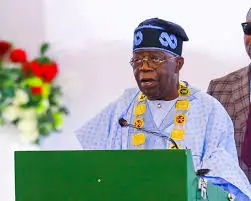
President Bola Tinubu has invited Guinea’s transitional President, Mamadi Doumbouya, to Nigeria for a state visit as both countries move to strengthen diplomatic and economic cooperation, particularly in the mining and minerals sector.
The meeting between the two leaders took place on Thursday on the sidelines of the Africa CEO Forum in Kigali, Rwanda, where African presidents, investors and business leaders gathered to discuss economic growth, investment and regional integration across the continent.
Tinubu’s Special Adviser on Media and Publicity, Sunday Dare, disclosed details of the bilateral engagement while briefing journalists after the president’s meetings at the summit.


According to Dare, Tinubu formally invited Doumbouya to Abuja for a state visit, an invitation the Guinean leader reportedly welcomed warmly.
“The President had a fruitful meeting, and you know Guinea is in debt to our president; he got some very good advice. Very soon, on the invitation of President Tinubu, he is likely to visit Nigeria,” Dare said while addressing reporters in Kigali.
The discussions between both leaders centred largely on economic cooperation and opportunities in Guinea’s extensive mineral and metals industry, which is regarded as one of the richest in Africa.
Dare said the bilateral talks opened a new pathway for strategic partnerships between Nigeria and Guinea, especially in areas involving solid minerals, infrastructure development and industrial investment.
“Guinea has a lot of potential, metals, minerals, and so on. The opening for partnership between Nigeria and Guinea has been opened. The possibilities are great, and I’m sure we will see that develop in the days and years ahead,” he added.
Guinea is globally recognised for holding the world’s largest reserves of bauxite, the primary ore used in aluminium production. The West African country also possesses substantial deposits of iron ore, gold and diamonds, making it one of the continent’s most strategically important mining economies.
The latest diplomatic engagement comes as Tinubu’s administration intensifies efforts to reposition Nigeria’s solid minerals sector as a major revenue source outside crude oil. Since assuming office in 2023, the federal government has repeatedly pushed for deeper foreign investment in mining, local processing and cross-border industrial partnerships.
Analysts say closer cooperation with Guinea could provide Nigeria with strategic access to raw materials and investment opportunities capable of supporting industrial expansion, manufacturing and regional trade.
The talks also carried political significance given Guinea’s ongoing transition process under Doumbouya, who came to power following the 2021 military takeover that removed former President Alpha Condé.
Although Guinea has faced sustained pressure from regional bodies, including the Economic Community of West African States, to return to democratic governance, Doumbouya has continued efforts to stabilise the country politically while pursuing economic reforms.
Reports from Guinea indicate that parliamentary elections are expected within weeks as part of the broader transition timetable toward civilian rule.
Tinubu, who currently chairs the Authority of ECOWAS Heads of State and Government, has remained actively involved in diplomatic engagements across West Africa, particularly on issues relating to democratic transitions, economic integration and regional security.
The meeting in Kigali also reflects Nigeria’s wider foreign policy push to deepen ties with strategic African economies at a time of growing competition for critical minerals globally.
Attention is now expected to shift toward the planned Abuja visit by Doumbouya and whether both countries will formalise new agreements around mining cooperation, infrastructure investment and trade partnerships in the coming months.