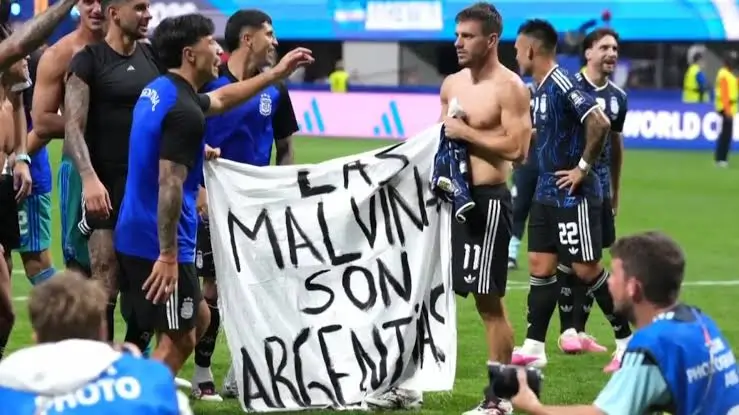
Argentina could face disciplinary action from FIFA after several of the country’s players celebrated their dramatic FIFA World Cup semi-final victory over England by displaying a politically charged banner supporting Argentina’s claim to the Falkland Islands.
The reigning world champions booked their place in Sunday’s World Cup final after staging a stunning late comeback to defeat England 2-1 at the Mercedes-Benz Stadium in Atlanta. England had looked on course for victory after Anthony Gordon’s second-half opener before Enzo Fernández equalised in the closing stages and Lautaro Martínez struck a dramatic stoppage-time winner to send Argentina into another World Cup final.
Moments after the final whistle, several Argentina players unfurled a banner reading “Las Malvinas son Argentinas” (“The Falklands are Argentine”), reviving one of the most sensitive political disputes between Argentina and the United Kingdom.
READ ALSO



Under FIFA regulations, political, ideological and religious messages are prohibited during official competitions. The governing body has previously disciplined national associations over similar incidents, leaving Argentina vulnerable to possible sanctions if the incident is found to have breached its disciplinary rules.
The controversy mirrors an incident in 2014 when FIFA fined the Argentine Football Association after the national team displayed an almost identical banner before an international friendly against Slovenia. At the time, football’s governing body ruled that the display violated its regulations on political messaging and team misconduct.
The Falkland Islands, known in Argentina as Las Malvinas, have remained at the centre of a sovereignty dispute for nearly two centuries. Britain has administered the South Atlantic archipelago since 1833, while Argentina continues to maintain its claim over the territory.
The dispute escalated into the 1982 Falklands War, a 74-day conflict that claimed the lives of 655 Argentine military personnel, 255 British servicemen and three civilians from the islands. Although Britain retained control after the war, the issue remains one of Argentina’s most emotionally charged national causes.
Political tensions had already surrounded Wednesday’s semi-final long before kick-off.
Argentina’s Vice-President, Victoria Villarruel, celebrated the victory on X, writing that it “wasn’t just another match” alongside a video appearing to show Argentine soldiers.
She added: “The Falklands are Argentine. They banned bringing them to the stadium and forgot that we carry them in our blood and our hearts.”
Before the match, Villarruel had also described the encounter as an opportunity to “put the invaders in their place,” remarks that drew renewed attention after Argentina’s victory.
Earlier in the tournament, Argentina’s squad had also attracted headlines after singing chants referencing the Falkland Islands following their Round of 16 victory, further fuelling debate over the intersection of football and politics.
Despite the growing controversy, Argentina manager Lionel Scaloni had insisted before the semi-final that football should remain separate from historical disputes.
“The reality is that this is a football match. I can’t mix things up, especially out of respect for what happened so many years ago,” Scaloni told reporters.
“It was a very sad period in our history. We remember those people, of course. But it is a football match—we shouldn’t confuse the two.”
His remarks stood in stark contrast to the scenes that unfolded after the final whistle, with the banner display quickly dominating post-match discussions around the world.
FIFA had not issued an official statement on the incident as of Thursday. However, the governing body is expected to review the post-match celebrations in line with its rules prohibiting political messages during official competitions. If disciplinary action is taken, Argentina is likely to face a financial penalty rather than any sporting sanction, based on previous FIFA rulings.
With the FIFA World Cup final against Spain just days away, the controversy has shifted attention from Argentina’s remarkable comeback victory to renewed debate over whether political symbolism has any place on football’s biggest stage.