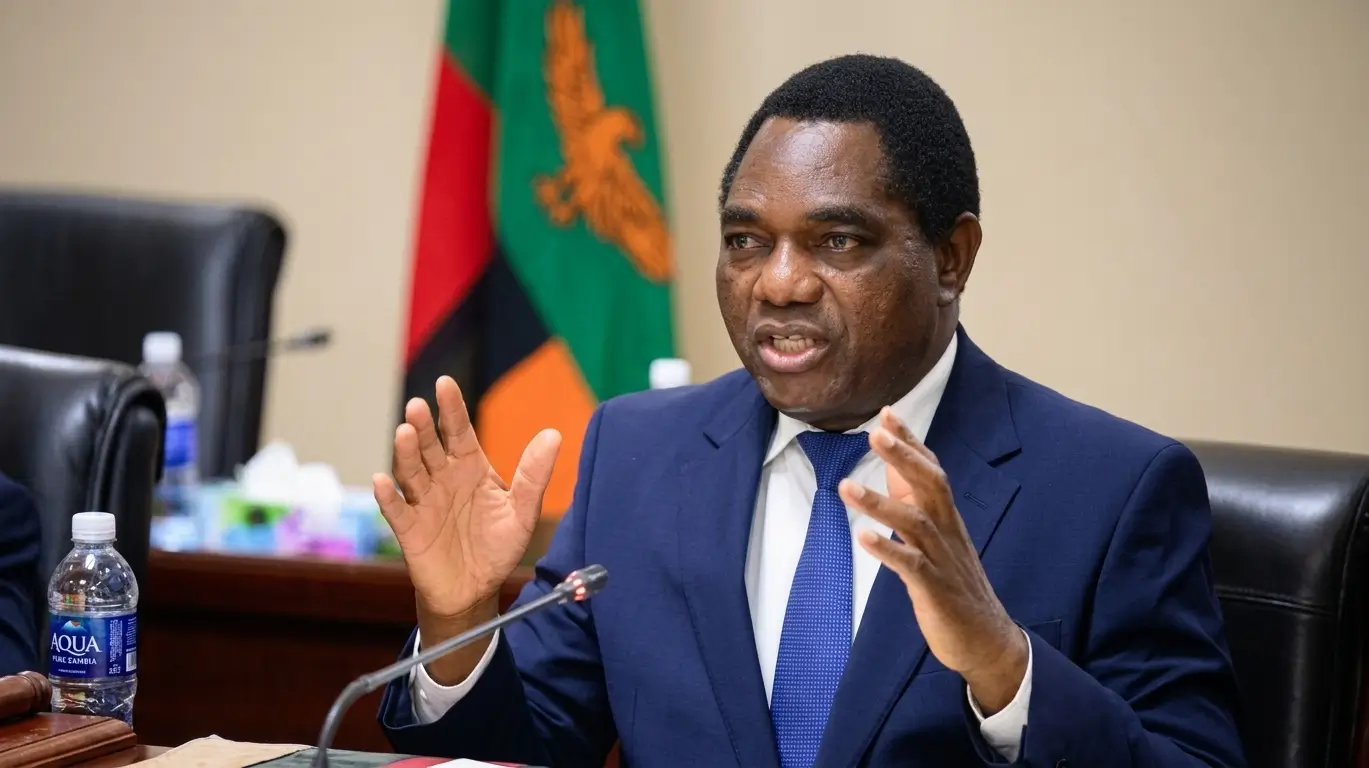
Zambian President Hakainde Hichilema has begun his second term in office under intense political scrutiny, following a disputed election and the detention of his main challenger, Brian Mundubile, on treason charges.
Hichilema, 64, was sworn in on Tuesday at the National Heroes Stadium in Lusaka, where thousands of supporters of his United Party for National Development gathered for the ceremony.
Several African leaders attended the inauguration, including Kenya’s William Ruto, Tanzania’s Samia Suluhu Hassan, Zimbabwe’s Emmerson Mnangagwa and Namibia’s Netumbo Nandi-Ndaitwah.


The ceremony came less than three weeks after the August 13 presidential election, in which official results gave Hichilema 2,965,326 votes, representing about 60.5 per cent, against 1,856,217 votes, or about 37.9 per cent, for Mundubile.
Hichilema was formally declared the winner on August 18.
Mundubile rejected the result and had indicated plans to challenge the election outcome. His attempt to pursue a legal challenge was complicated by the closure of Zambia’s courts on August 24, the final day for filing a presidential election petition.
The European Union Election Observation Mission raised concerns about aspects of the electoral process, although it said voting on election day was generally peaceful and competitive.
The EU later pointed to restrictions on campaigning and advantages associated with incumbency, saying these contributed to an uneven playing field. It also raised concerns about serious incidents and procedural irregularities during the counting and tabulation of results.
Political tensions escalated after security forces raided a property linked to Mundubile in Lusaka on August 14.
Authorities said the operation was connected to a suspected national-security threat and alleged the existence of a militia. The opposition rejected the claims.
A former cabinet minister was killed during the operation, while several opposition figures were arrested.
Mundubile and his running mate, Makebi Zulu, later surrendered to police after spending days in hiding. Their lawyer confirmed that the pair had been formally charged with treason alongside other suspects.
They have denied the allegations.
The development has cast a shadow over Hichilema’s inauguration, with the president beginning a fresh five-year mandate while his principal electoral opponent remains in detention.
In his inauguration speech, Hichilema did not directly address Mundubile’s detention but called for political tolerance and cooperation.
“Democracy does not require us to agree on everything. It requires us to respect one another even when we disagree,” he said.
The president also invited the opposition to work with his administration, saying his government would listen when opponents had good ideas.
Hichilema’s second-term agenda is expected to focus strongly on economic growth after his first administration pursued debt restructuring, fiscal reforms and social programmes, including free primary and secondary education.
The former businessman has been credited with helping stabilise Zambia’s economy after inheriting a country struggling with debt and high inflation in 2021.
His government now says the focus must shift from stabilisation to growth and prosperity.
Yet the political challenges surrounding his second mandate may prove equally significant.
With questions raised over the election process, the closure of the courts during the petition window and the prosecution of opposition figures, Hichilema faces pressure to demonstrate that Zambia’s reputation for democratic stability remains intact.