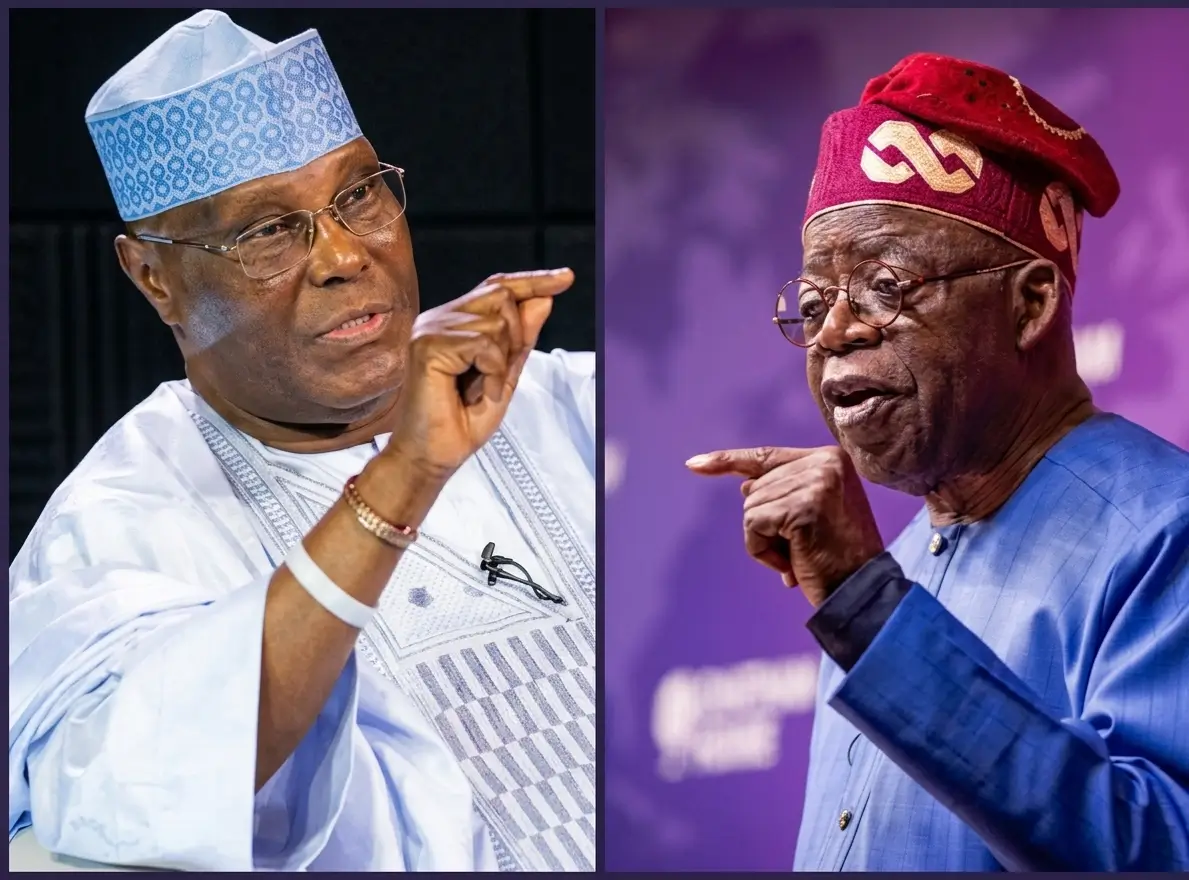
Former Vice President and African Democratic Congress presidential candidate, Atiku Abubakar, has hit back at President Bola Tinubu over his criticism of the proposal to reintroduce government intervention in petrol pricing, insisting that Nigerians are bearing the brunt of the administration’s economic reforms.
Atiku’s response followed Tinubu’s description of his proposed return to fuel subsidy as evidence of “serious ignorance on governance and economy.”
Tinubu made the remark on Thursday, August 20, while receiving Osun State Governor Ademola Adeleke at the Presidential Villa in Abuja.




Atiku had earlier said that, if elected president in 2027, he would restore fuel subsidy and seek to recover funds allegedly lost through corruption.
“I did not oppose the removal of the oil subsidy, but where is the money?” Atiku said in an interview.
However, in a statement issued on Friday by his Senior Special Assistant on Public Communication, Phrank Shaibu, Atiku clarified that his proposal should not be interpreted as a return to the former open-ended subsidy regime.
Instead, he said he was proposing a targeted, capped, budgeted and time-bound production-support mechanism tied to domestic refining and subject to independent auditing.
“The real ignorance is believing suffering is economic policy,” Atiku said.
The former vice-president argued that Nigeria’s economic circumstances had changed significantly since Tinubu removed petrol subsidy in May 2023.
According to him, the policy, combined with foreign-exchange reforms, had contributed to higher petrol, transport and food costs, while the naira’s depreciation weakened household purchasing power.
Atiku also challenged the government’s assertion that subsidy had been completely eliminated, pointing to petroleum-sector costs and under-recoveries which he said amounted to about ₦17.5tn.
“If subsidy is dead, why are under-recoveries alive?” he asked.
He also demanded explanations over about ₦30tn in Federation Account revenues, deductions, savings and transfers, as well as the ₦12.8tn Service-Wide Vote contained in the 2026 budget.
Atiku argued that increased government revenue and larger allocations to states should not automatically be presented as proof of economic success if ordinary Nigerians are losing purchasing power.
“You do not build a federation by impoverishing citizens so that Abuja can send bigger cheques to governors,” he said.
The Presidency has strongly rejected Atiku’s position, maintaining that the former subsidy system was financially unsustainable and associated with significant distortions and leakages.
Tinubu has repeatedly defended the decision to remove the subsidy, arguing that it was necessary to restore Nigeria’s fiscal stability and redirect resources towards infrastructure and essential services.
The government has also pointed to increased Federation Account allocations as one of the benefits of the reform.
The petroleum market itself has changed since 2023, with the emergence of large-scale domestic refining capacity, particularly the Dangote refinery.
But petrol prices remain vulnerable to international crude prices, foreign-exchange movements and domestic crude-supply constraints.
The dispute has consequently evolved into a larger political argument over whether Nigeria should continue with Tinubu’s reform path or introduce new interventions to cushion consumers.
For Atiku, the priority is reducing the burden on households while supporting domestic production. For Tinubu, reversing subsidy reforms risks reopening the fiscal problems that prompted the policy in the first place.
With the 2027 presidential race gathering momentum, the battle over petrol subsidy is shaping up as one of the defining economic issues of the election.