


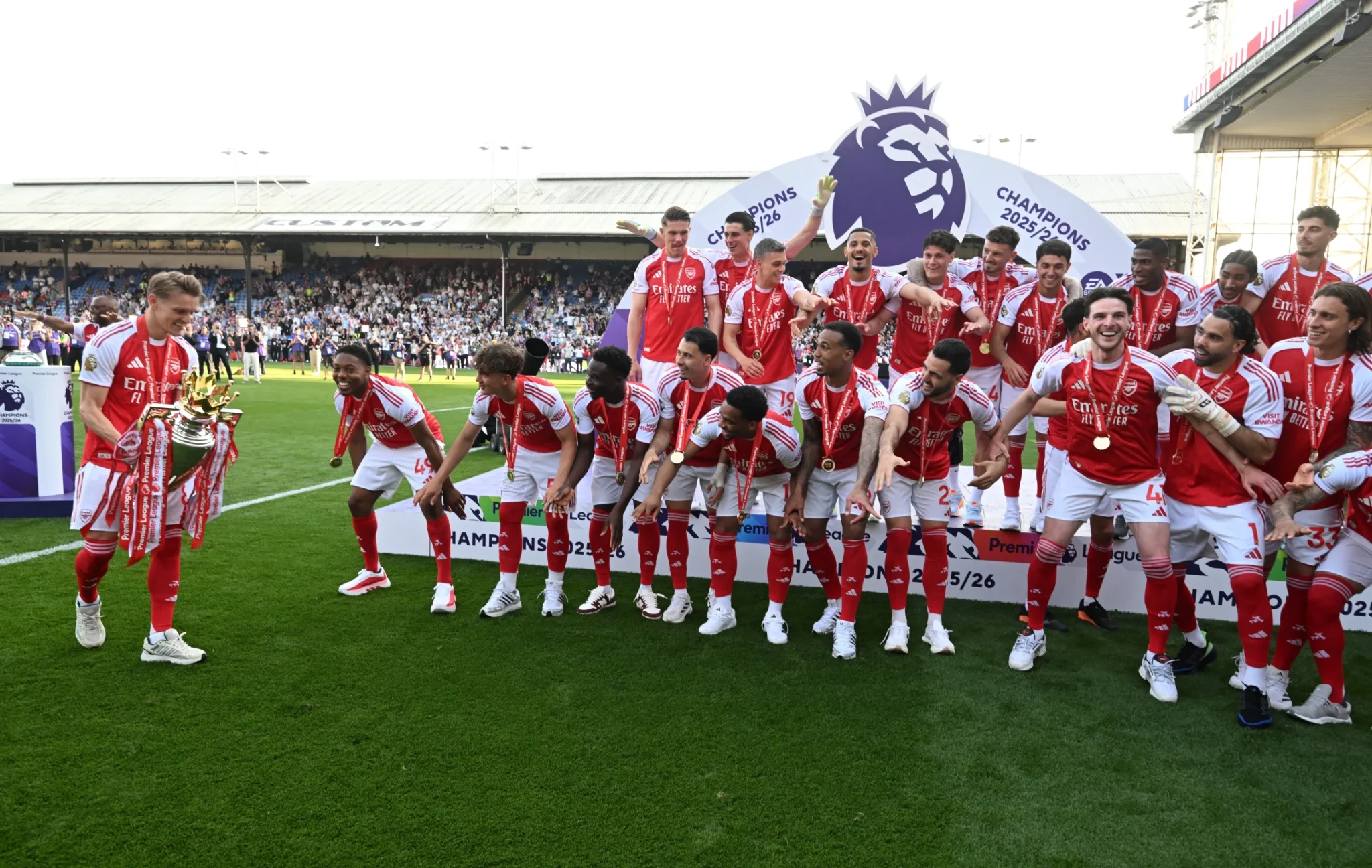
Arsenal’s long-awaited Premier League triumph was not simply the culmination of a successful football season but the result of a years-long cultural overhaul spearheaded by manager Mikel Arteta.
The North London club ended a 22-year wait for the English league title after clinching the 2025/26 Premier League crown, completing a remarkable transformation that began when Arteta was appointed manager in December 2019 following years of inconsistency and near misses.
According to the club, the success was built on a shared commitment from the coaching staff, board, players and supporters, all of whom embraced a long-term vision despite periods of intense scrutiny.



Reflecting on the emotional moment captain Martin Ødegaard lifted the Premier League trophy, Arteta admitted the reality surpassed everything he had imagined.
“It was much better. I was just looking at the players’ faces, how much it means to them, and to see them gathering together and lifting it. It was incredible.”
The achievement sparked celebrations far beyond North London.
Around one million supporters lined the streets of Islington during the victory parade, while fans celebrated across countries including Nigeria, Kenya, Uganda, India, China, Ethiopia and Australia, highlighting Arsenal’s enormous global following.
The club described the scenes as transcending football, recalling celebrations ranging from supporters climbing trees in London to a church congregation in Lagos singing in honour of Arsenal’s championship success.
One of Arsenal’s newest arrivals, Eberechi Eze, described the title as something much bigger than football.
“This isn’t just about winning the title as a group of players. This is about something that represents an area, represents values, represents people’s dreams. Arsenal is the culture club.”
According to Arsenal, that culture became the foundation of the club’s resurgence.
Co-chair Josh Kroenke revealed that conversations during Arteta’s recruitment focused less on tactics and more on rebuilding the club’s identity.
“When the time came to hire Mikel, the entire conversation we had with him was about culture and reinventing that,” Kroenke said, adding that Arteta immediately understood the scale of the rebuilding task.
That philosophy also shaped Arsenal’s transfer strategy.
Sporting director Andrea Berta explained that improving the character of the dressing room became just as important as strengthening the squad technically.
“Our first objective was to improve the team humanly because the group’s integrity and maturity were the most important aspects,” he said.
Captain Martin Ødegaard said togetherness became one of Arsenal’s greatest strengths.
“We really care for each other. We really help each other. We fight for each other. We give everything, every single day, for each other.”
On the pitch, Arsenal’s title-winning campaign combined defensive discipline with consistency across the squad.
Goalkeeper David Raya, defenders William Saliba and Gabriel Magalhães, midfielder Declan Rice and several match-winners were highlighted as key figures in a season defined by resilience rather than dependence on one player.
The defining stretch came during the closing weeks of the campaign.
Despite setbacks and growing pressure in the title race, Arteta repeatedly urged supporters to remain united.
“Jump in this boat. It is going to be fun. A lot of incredible things are going to emerge.”
Declan Rice’s message after defeat to Manchester City — “It’s not done” — became an internal rallying cry as Arsenal refused to surrender belief before eventually securing the championship.
For Arsenal, the title represents far more than ending a two-decade wait. It validates a rebuilding process built on patience, leadership, togetherness and belief, restoring the club to the summit of English football and laying the foundation for sustained success.