



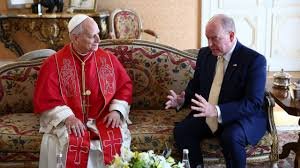
Pope Leo Monaco Visit: The Pope Monaco Visit marked a historic moment as Pope Leo XIV chose Monaco — one of the wealthiest enclaves in the world — for his first Western European trip since becoming pontiff. During the visit, he delivered a powerful message warning against the growing divide between the rich and the poor, while urging global leaders to prioritize peace and justice.
The pope’s arrival in the Mediterranean principality drew crowds, religious leaders, and government officials, highlighting the symbolic importance of the trip and its broader global message.
Overview of the Pope’s Visit to Monaco
The pontiff arrived by helicopter from Rome and was welcomed by Monaco’s ruler, Prince Albert II, alongside his wife, Princess Charlene, at the Monte Carlo heliport. The sunny arrival set the tone for what would become a significant diplomatic and spiritual event.


Soon after landing, Pope Leo XIV addressed the public from the balcony of the Prince’s Palace. Speaking in French, he highlighted the widening economic gap and criticized what he described as “structures of sin” that deepen divisions between wealth and poverty.
His remarks emphasized the need for wealth to serve justice and law, particularly during a period marked by rising geopolitical tensions and global conflicts.
Key Developments During the Visit
The Pope’s visit to Monaco included several major moments that underscored both religious and political themes:
- Church bells rang across Monaco to welcome the pontiff
- Residents gathered, waving Monaco and Vatican flags
- Businesses decorated streets in red, white, yellow, and gold
- The Popemobile passed along Rue Grimaldi, where crowds gathered
After addressing the public, Pope Leo XIV visited the Cathedral of the Immaculate Conception to meet with the Catholic community. He later proceeded to the square near the Church of Saint Devota, dedicated to the principality’s patron saint.
The highlight of the day was scheduled to be an open-air mass at Louis II Stadium, where approximately 15,000 people were expected to attend.
Why the Pope Chose Monaco
The choice of Monaco surprised observers. Known as a haven for millionaires, the small state on the French Riviera between France and Italy represents wealth and luxury.
Yet, the pope’s message targeted this very contrast.
Billboards displaying the pontiff in religious attire stood alongside luxury sports cars and tourist crowds, visually reinforcing the pope’s concerns about economic disparities.
Despite its wealth, Monaco remains one of the few European states where Catholicism is still the official religion. The principality also maintains long-standing diplomatic ties with the Holy See.
Interestingly, only about eight percent of Monaco’s citizens identify as practicing Catholics. However, churches remain one of the rare places where individuals from vastly different economic backgrounds gather together.
Message on Peace, Life, and Environment
According to Vatican spokesperson Matteo Bruni, the Pope’s visit to Monaco would also focus on:
- Environmental protection
- Monaco’s role in Europe
- Protection of life in all forms
Environmental protection is a key issue for Prince Albert II, who has long championed sustainability efforts.
The pope’s reference to “protection of life” also touched on broader moral issues, including opposition to abortion and euthanasia — both topics relevant within Monaco’s legal and religious framework.
Additionally, the pope used the opportunity to address global conflicts, particularly tensions affecting the Middle East and the global economy.
Impact of the Visit on Monaco and Europe
Prince Albert II described the visit as an important moment for Monaco’s international standing. Speaking to local newspaper Nice-Matin, he said the pope’s visit reflected Monaco’s significance in the Catholic world.
The prince also highlighted shared priorities between Monaco and the Vatican, including:
- Promoting international solidarity
- Encouraging peace initiatives
- Supporting sports diplomacy
The Pope’s visit to Monaco also drew mixed reactions among locals. While some residents expressed indifference, others viewed the moment as historic.
Isabel Fissore, a 62-year-old jewelry shop owner, described the meeting as meaningful, noting that two of the world’s smallest states were coming together to promote peace and unity.
A Symbol of Cultural Diversity
Monaco’s religious leaders emphasized the broader significance of the visit. Dominique-Marie David, Archbishop of Monaco, highlighted the principality’s cultural diversity, noting that residents from about 140 nationalities live there.
He explained that the pope’s visit represented outreach to multiple cultures, languages, and communities.
This diversity, combined with economic contrasts, reinforced the pope’s message about unity and compassion.
Future Outlook After the Pope’s Visit to Monaco
The Pope’s visit to Monaco may influence future diplomatic and religious engagements across Europe. Analysts believe the pope’s emphasis on inequality, peace, and environmental protection could shape his broader agenda.
As global tensions continue to rise, the pontiff’s message from one of the world’s wealthiest locations carried symbolic weight.
By choosing Monaco, Pope Leo XIV highlighted a global issue — inequality — from a setting that visually represents economic extremes.
The visit also strengthened ties between Monaco and the Vatican, while offering a platform for discussions on peace, justice, and sustainability.
Conclusion
The Pope’s visit to Monaco delivered more than ceremonial appearances. It offered a strong moral message about inequality, global conflict, and the responsibility of wealth.
In a principality known for luxury and affluence, Pope Leo XIV’s message resonated as a call for unity, compassion, and peace — themes that continue to shape his papacy.