



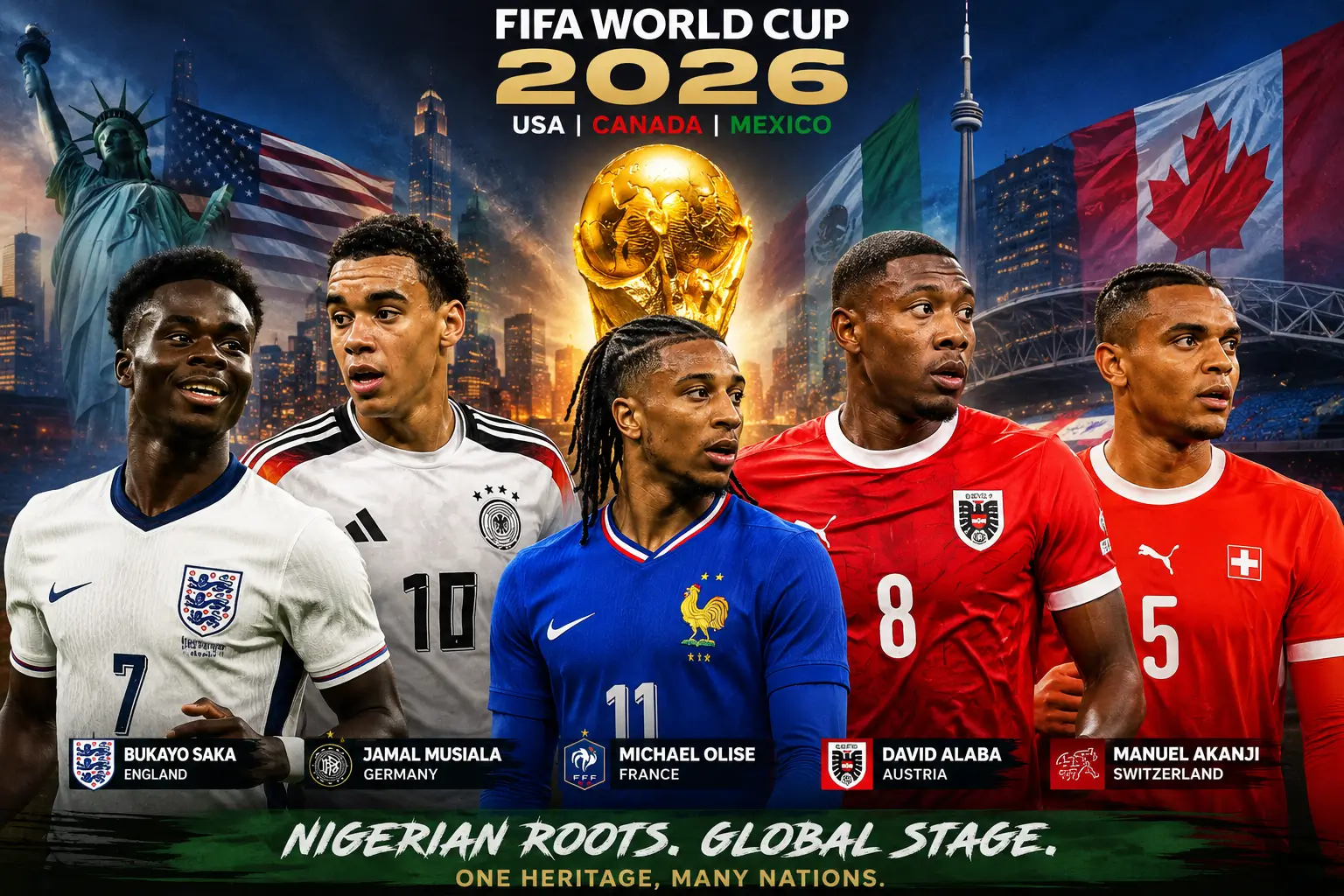
Nigeria may not be among the 48 nations competing at the FIFA World Cup 2026, but the country’s football footprint will remain impossible to ignore as a significant number of players of Nigerian descent prepare to represent other nations at the tournament.
The World Cup kicks off on June 11 across the United States, Mexico, and Canada in what is FIFA’s first-ever 48-team edition and the first tournament to be jointly hosted by three countries.
The Super Eagles‘ absence marks a second consecutive World Cup without Nigeria following the country’s failure to reach Qatar 2022. Yet, attention among Nigerian football fans has increasingly shifted to a growing list of diaspora stars expected to feature for some of the tournament’s biggest contenders.




Among the most prominent names is England’s trio of Bukayo Saka, Eberechi Eze, and Noni Madueke, all of whom have Nigerian family roots.
Germany will also parade Nigerian-linked talent through Jamal Musiala and Felix Nmecha, while France’s squad includes Michael Olise, who was eligible to represent several countries before committing to Les Bleus.
For Switzerland, defenders and forwards with Nigerian heritage such as Manuel Akanji and Noah Okafor are expected to feature.
Austria captain David Alaba remains one of the most celebrated footballers with Nigerian roots, while Carney Chukwuemeka has also been mentioned among players of Nigerian ancestry expected at the tournament.
North America will also showcase Nigerian heritage through the United States’ Folarin Balogun, Canada’s Tani Oluwaseyi, Promise David, and Owen Goodman.
Other players frequently cited in discussions about Nigeria’s global football influence include Norway’s Antonio Nusa and South Africa’s Ime Okon.
The presence of these players across multiple national teams has reignited debate among supporters about the vast pool of Nigerian talent developed both at home and abroad. Discussions on social media have even produced hypothetical “Nigerian XI” line-ups featuring stars such as Saka, Musiala, Olise, Akanji, and Alaba—a team many fans argue could compete with some of the strongest sides in international football.
The conversation also highlights the growing challenge faced by African football powers in retaining dual-nationality talents, particularly those developed in European academies.
While Nigeria’s players will be watching from home, the country’s influence will still be visible throughout the tournament, with Nigerian heritage represented across several squads competing for football’s biggest prize. The 2026 World Cup will run until July 19, when the champion will be crowned in New York/New Jersey.
Optional Image Suggestion:
Collage featuring Bukayo Saka, Jamal Musiala, Michael Olise, David Alaba, and Manuel Akanji with a FIFA World Cup 2026 backdrop.