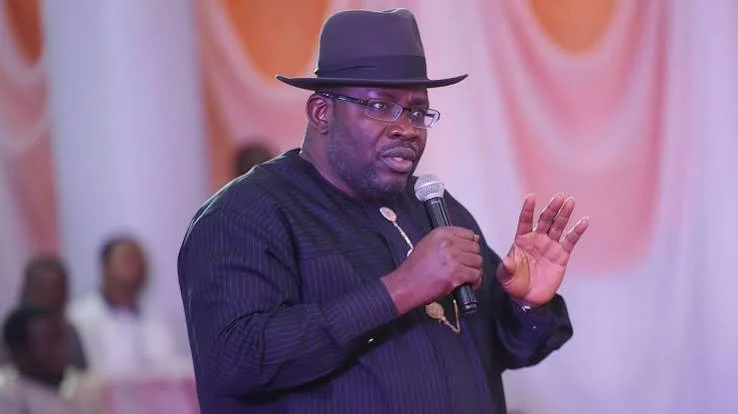
National Leader of the Nigeria Democratic Congress, Senator Seriake Dickson, has backed the G100’s efforts to unite opposition parties ahead of the 2027 general elections, but said the NDC remains focused on winning the election with its existing presidential ticket.
Dickson stated this while appearing on Arise Television’s Prime Time, where he acknowledged the consultations being led by the G100 to develop a common opposition front and possibly produce a consensus presidential candidate.
He said the initiative was not misplaced and that the NDC, in principle, supported the effort.

“My friends who are organising the G100 came to see me, Saliu and his people. They are great Nigerians doing a great job, and their thinking is not misplaced,” Dickson said.
The former Bayelsa State governor, however, stressed that the NDC had already settled its presidential ticket and would campaign as a party while remaining open to cooperation with other political groups.
“We are going into the election as NDC,” he said.
Dickson said the party would welcome support from other parties and candidates if they chose to back the NDC, but maintained that its priority was to secure victory at the polls.
He described the party’s ticket as “exciting”, “vibrant” and “balanced”, insisting that it resonates with Nigerians at home and abroad.
The NDC adopted former Anambra State Governor Peter Obi as its presidential candidate and former Kano State Governor Rabiu Kwankwaso as his running mate at its special convention in Abuja in May.
The party had earlier zoned its 2027 presidential ticket to Southern Nigeria for a single four-year term, with the 2031 ticket allocated to Northern Nigeria.
Dickson’s comments come amid renewed efforts by the G100 to forge a united opposition front ahead of the 2027 election.
The group has consulted six opposition parties — the African Democratic Congress, Allied Peoples Movement, NDC, Peoples Democratic Party, Peoples Redemption Party and Social Democratic Party — over possible cooperation.
Representatives of the six parties later met at the G100 First Summit of Nigeria’s Opposition Political Parties at the Shehu Musa Yar’Adua Centre in Abuja.
The summit produced an agreement to begin structured negotiations on opposition cooperation and develop a framework for working together ahead of the election.
The G100 is also seeking a roadmap towards a common presidential candidate, alongside proposals for a single-term transition government and a broader national reform programme.
The initiative is aimed at avoiding a repeat of the fragmented opposition vote that characterised the 2023 presidential election, when major opposition figures contested separately.
However, producing a consensus candidate is expected to be difficult because the participating parties already have established candidates, political structures and competing interests.
For the NDC, Dickson’s comments indicate that the party is willing to participate in the wider opposition process without automatically surrendering its Obi-Kwankwaso ticket.
The party’s preferred outcome could therefore be cooperation around its existing ticket, rather than reopening the presidential nomination.
Dickson said the NDC would continue to work with political parties and groups willing to support its campaign.
“But we are working to win the election,” he said.
The statement highlights the central challenge facing the emerging opposition alliance: finding a formula that can unite the parties without forcing them to abandon their individual political interests and presidential ambitions.