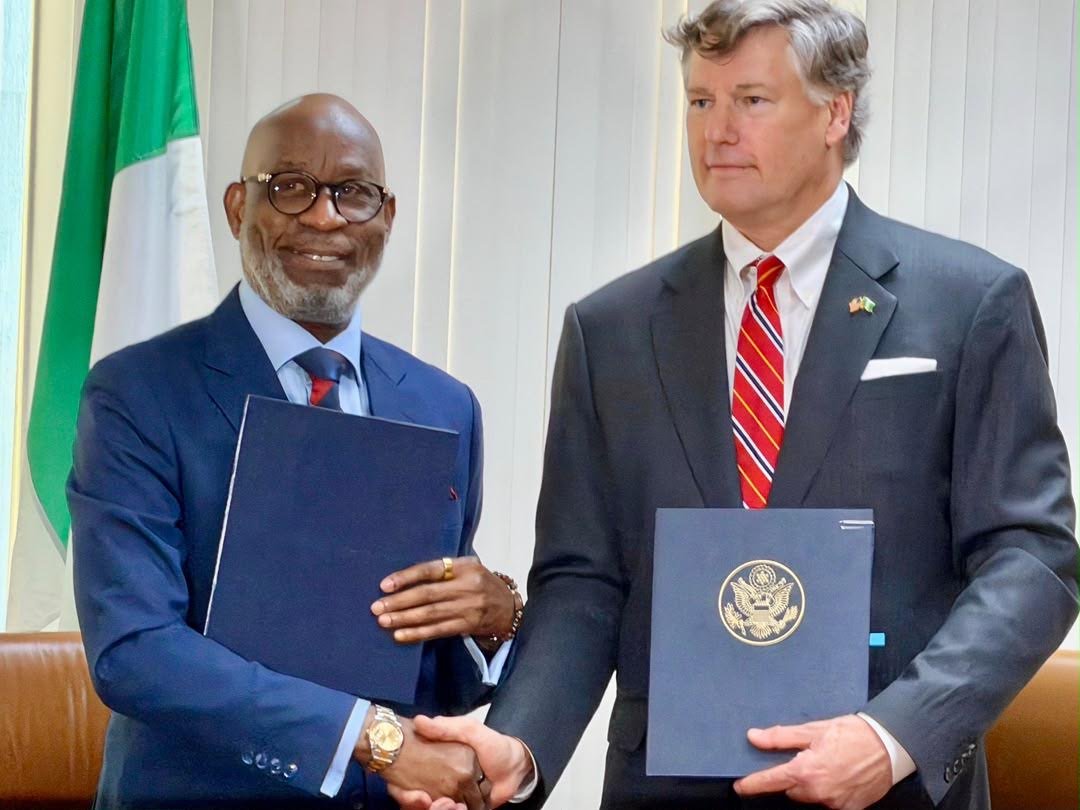
Nigeria and the United States have signed a framework agreement aimed at deepening American investment in Nigeria’s mining industry and accelerating the development and processing of the country’s mineral resources.
The agreement was signed on Wednesday in New York by Nigeria’s Minister of Solid Minerals Development, Dele Alake, and US Deputy Secretary of State Christopher Landau at the Nigeria Mission House on the sidelines of the 81st United Nations General Assembly.

Alake announced the development on Thursday, describing the agreement as an important step in strengthening Nigeria-US cooperation across the mineral value chain.




According to the minister, the framework covers geological data and exploration, mineral development and processing, infrastructure and technical capacity building.
Nigeria estimates its mineral resources at about $700 billion, with the Federal Government seeking to attract more investment into a sector it sees as important to economic diversification.
Alake said the country could not continue to export raw materials while other countries captured most of the value through processing and manufacturing.
“This is an important step in strengthening Nigeria-US cooperation around our mineral resources, valued at about $700 billion,” he said.
“Nigeria cannot remain a source of raw materials while others capture most of the value. We want more local processing, quality jobs, stronger skills and greater opportunities for Nigerian businesses.”
The agreement comes amid growing international competition for critical minerals used in technologies such as electric vehicles and renewable-energy infrastructure.
Nigeria’s emerging lithium sector has also attracted foreign investment, while the Federal Government is seeking to develop a broader mineral value chain spanning exploration, processing and infrastructure.
Landau said the United States was interested in strengthening its partnership with Nigeria and supporting the country’s economic growth.
The framework is expected to provide a basis for cooperation in geological information, exploration, mineral development, processing, infrastructure and technical skills.
For Nigeria, however, the next phase will be turning the agreement into concrete projects and investments.
Alake said the government would identify viable projects and develop partnerships capable of delivering value to Nigerians and American investors.
“In the coming months, we will turn this framework into projects, investments and real results for our people,” he said.
The minister’s position reflects the Federal Government’s broader push to reduce dependence on crude oil and increase the contribution of solid minerals to the Nigerian economy.
Earlier this week, Alake also called for stronger safety measures and greater formalisation of artisanal mining, including proposals for a Mine Emergency and Community Development Fund.
The Nigeria-US agreement consequently comes at a time when Abuja is seeking both foreign capital and greater domestic capacity to turn mineral deposits into processing, industrial and employment opportunities.
Alake said the government would move from the framework to identifying viable projects and building partnerships in the coming months.