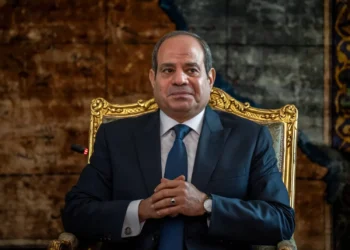



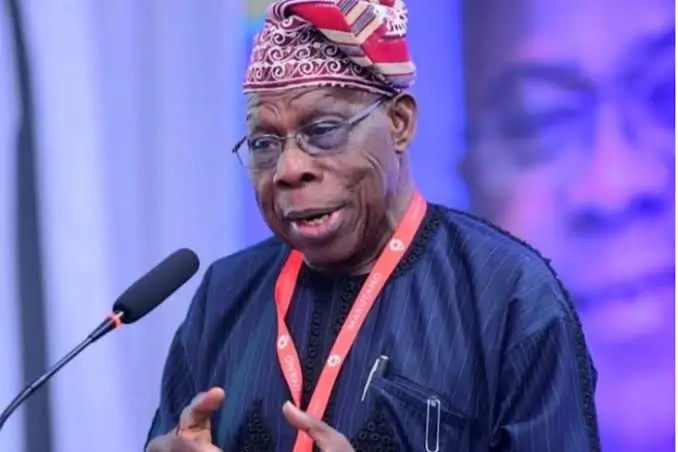
Former President Olusegun Obasanjo has criticised President Bola Tinubu’s borrowing policy, warning that excessive debt could mortgage Nigeria’s future and impose an unbearable burden on generations yet unborn.
Obasanjo also described Tinubu’s assertion that borrowing was not leprosy as “absolute nonsense”, arguing that the consequences of excessive indebtedness could extend beyond an individual to affect entire generations.
The former president spoke on Friday at the Ajibosin Platform, a public forum themed “Leveraging Artificial Intelligence to Solve Grassroots Problems and Accelerate National Development”, held in Abeokuta, Ogun State.
Tinubu had, in April, defended his administration’s borrowing policy, insisting that the government would continue to obtain loans whenever necessary to finance its programmes.
The President made the remarks at the State House during a meeting with Plateau State leaders led by Governor Caleb Mutfwang and the All Progressives Congress National Chairman, Nentawe Yilwatda.

“If we have to borrow, we borrow. Borrowing is not leprosy, we just have to work hard to be able to pay for it,” Tinubu had said.
Reacting to the statement, Obasanjo argued that debt could have more devastating consequences than leprosy because its effects could be transferred across generations.
“And for anybody to say debt is no leprosy, is absolute nonsense. Debt is worse than leprosy. Because leprosy destroys only one person. Debt destroys generations,” he said.
The former president also expressed concern over Nigeria’s economic performance, particularly the depreciation of the naira against the United States dollar over the decades.
Using his agricultural experience to illustrate the country’s economic decline, Obasanjo recalled that when he established his farm 47 years ago, the exchange rate stood at approximately N1 to $1.85.
“When I started my farm, 47 years ago, naira to the dollar was one naira to $1.85. Forty-seven years ago. What has Nigeria done in 47 years that we now have 1,500 naira to the dollar? What have we done?” he asked.
He questioned the capacity of the country’s political leadership to formulate policies capable of improving living conditions and addressing Nigeria’s economic challenges.
“What do our leaders know? And what do they not know? And from what they know, what can they do for us?” he asked.
Obasanjo also criticised Nigeria’s reliance on economic recommendations from international financial institutions, particularly the World Bank and the International Monetary Fund.
He argued that the institutions were established under circumstances different from Nigeria’s and that their economic prescriptions did not always reflect the country’s peculiar development challenges.
“World Bank and IMF were not designed for us. They were not built by us. They were built before we became independent. And that’s the people who would determine what we do,” he said.
The former president recalled how Nigeria was discouraged from providing certain agricultural subsidies despite the support available to farmers in developed economies.
He further warned against the uncritical adoption of economic policies recommended by foreign-trained experts without adequately considering local realities.
According to him, some highly educated young economists may develop policies that appear sound academically but fail to address the practical challenges facing Nigeria.
“They are brilliant boys and girls, so they went to Ivy League universities, Oxford, Cambridge, and all that.
“These brilliant boys, then they put it, it’s good academically. And they tell us, and we take it, lock, stock and barrel, and we use it,” he said.
Obasanjo questioned why a country with an estimated population of about 250 million people would depend heavily on recommendations from young experts whom he suggested might lack sufficient practical experience in managing households and understanding the country’s complexities.
“For a country of 250 million people, it is boys and girls who are not even married, let alone manage a home, who will tell us how, what will we do to manage our country? And we swallow it. And we destroy ourselves,” he said.
His comments come amid continuing national debates over government borrowing, debt servicing, exchange-rate pressures and the effectiveness of economic reforms under the Tinubu administration.