Borno State Governor, Babagana Zulum, has accused metal scavengers of stealing wires purchased for an electricity distribution project valued at more than N3bn, citing the incident as one of the reasons for the state’s restrictions on scrap metal trading.
Zulum said the wires were bought for a power distribution line linking Damaturu, the Yobe State capital, to Maiduguri, Borno State, but were subsequently stolen through metal scavenging activities.




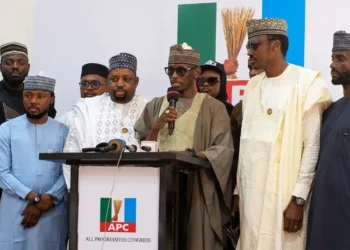
made the disclosure on Saturday while addressing scrap metal operators in Maiduguri, according to a statement issued on Sunday by his Senior Technical Assistant on Print and Digital Communications, Abdulrahman Bundi.
He said the restrictions were introduced to protect public infrastructure and address security concerns, insisting that the government had no personal interest in depriving traders of their livelihoods.
“We spent more than N3 billion to connect an electricity distribution line from Damaturu to Maiduguri, but unfortunately we lost all the wires to the metal scavenging activities,” Zulum said.
The governor also alleged that security intelligence had linked some scavengers to insurgents who use scrap metal businesses to dispose of stolen materials.
“We have security intelligence that even the insurgents use your platforms to sell looted metals. So, no responsible government will ignore such intelligence just to be politically correct,” he added.
Zulum said the restrictions were also informed by the deaths of scavengers operating in communities where security conditions remained unsafe for civilian activities.
“Before the ban, hundreds of your members were killed in the process of scavenging for metals in the villages that are not yet safe for civilian activities,” he said.
The governor maintained that the government was concerned about both the safety of the traders and the destruction of public assets, adding that the authorities would not ignore security warnings simply to avoid criticism.
Zulum considers possible review of ban
Despite defending the restrictions, Zulum indicated that his administration was prepared to consider proposals that could allow operators to resume their businesses without threatening public safety or infrastructure.
He met affected operators at the Government House in Maiduguri on Saturday and said the ban could be reviewed if traders demonstrated that their activities would not contribute to insecurity or the vandalism of public property.

The governor urged operators to submit practical proposals outlining how they could continue trading while ensuring that stolen electricity cables, metals and other public assets were not purchased through their businesses.
He also announced financial assistance of N200m to cushion the impact of the restrictions on affected operators.
As part of the arrangements, the state government granted a two-week waiver for traders to evacuate scrap metal stocks accumulated before the ban. Seventy-two locations were approved for the exercise.
The temporary concession was intended to allow operators to move existing stocks without automatically reopening the trade across the state.
Zulum urged the traders to use the opportunity to develop workable proposals that would address the government’s security concerns.
Security and infrastructure concerns
Borno has faced prolonged security challenges linked to the Boko Haram insurgency, making the protection of electricity installations, roads and other public assets a significant concern for authorities.
The governor imposed an executive ban on metal scavenging across the state’s 27 local government areas on July 10, 2023, citing the alleged vandalism of public infrastructure and security risks associated with the trade.
The wider problem of attacks on electricity infrastructure has also affected the Damaturu-Maiduguri corridor.
In 2024, the House of Representatives documented repeated attacks on the 330-kilovolt transmission line supplying Damaturu and Maiduguri, including an incident in which a transmission tower was pulled down near Kasaisa village in Yobe State. Lawmakers called for investigations and stronger protection of critical power infrastructure.
The governor’s latest comments highlight the challenge of balancing livelihoods with the protection of public assets in a region where insecurity continues to complicate infrastructure development.
For affected operators, any eventual relaxation of the restrictions will depend on whether they can present credible measures to prevent stolen metals from entering the scrap market.