
The debate sparked by First Lady Senator Oluremi Tinubu’s comments on akara frying and kulikuli production has found its way into academia, after a university examination in Kogi State adopted it as a case study.
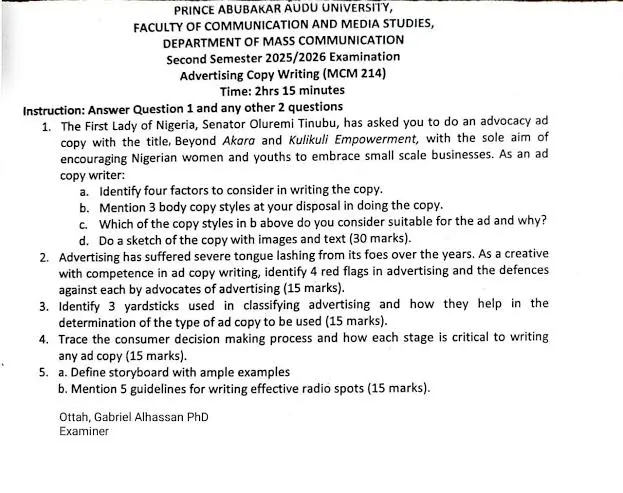
Students of the Department of Mass Communication at Prince Abubakar Audu University, Anyigba, were tasked with producing an advocacy advertising campaign based on the First Lady’s remarks during the second semester 2025/2026 examinations.
The question appeared in the Advertising Copy Writing (MCM 214) paper of the Faculty of Communication and Media Studies.




According to the examination paper, students were asked to develop an advocacy advertisement titled “Beyond Akara and Kulikuli Empowerment” aimed at encouraging women and youths to embrace small-scale businesses.
They were also required to identify factors to consider in writing the copy, discuss body-copy styles, justify the most appropriate approach and sketch the proposed advertisement.
The question accounted for 30 marks.
The examination reference comes weeks after Oluremi Tinubu urged Nigerians to explore low-capital ventures such as frying akara, roasting corn and producing kulikuli.

She made the remarks in June while addressing State House correspondents after a meeting of the Renewed Hope Initiative with wives of state governors in Abuja.
The comments generated widespread reactions online, with critics arguing that they appeared disconnected from the economic challenges confronting many Nigerians, including inflation, unemployment and rising food prices.
The First Lady later defended her position, saying the government’s empowerment initiatives extend beyond akara sellers to include traders dealing in tomatoes, vegetables, pepper and roasted plantain.
She also revealed that the Federal Government had provided N100 million to the Jigawa State Government to support 2,000 petty traders, with each beneficiary expected to receive N50,000 to boost their businesses.
Presidential aide Dada Olusegun subsequently defended the initiative, insisting critics had ignored the broader impact of the Renewed Hope Initiative on healthcare, women empowerment and vulnerable populations.
The examination question has continued to generate discussion online, with many describing it as an example of how contemporary national issues are increasingly being incorporated into classroom learning.