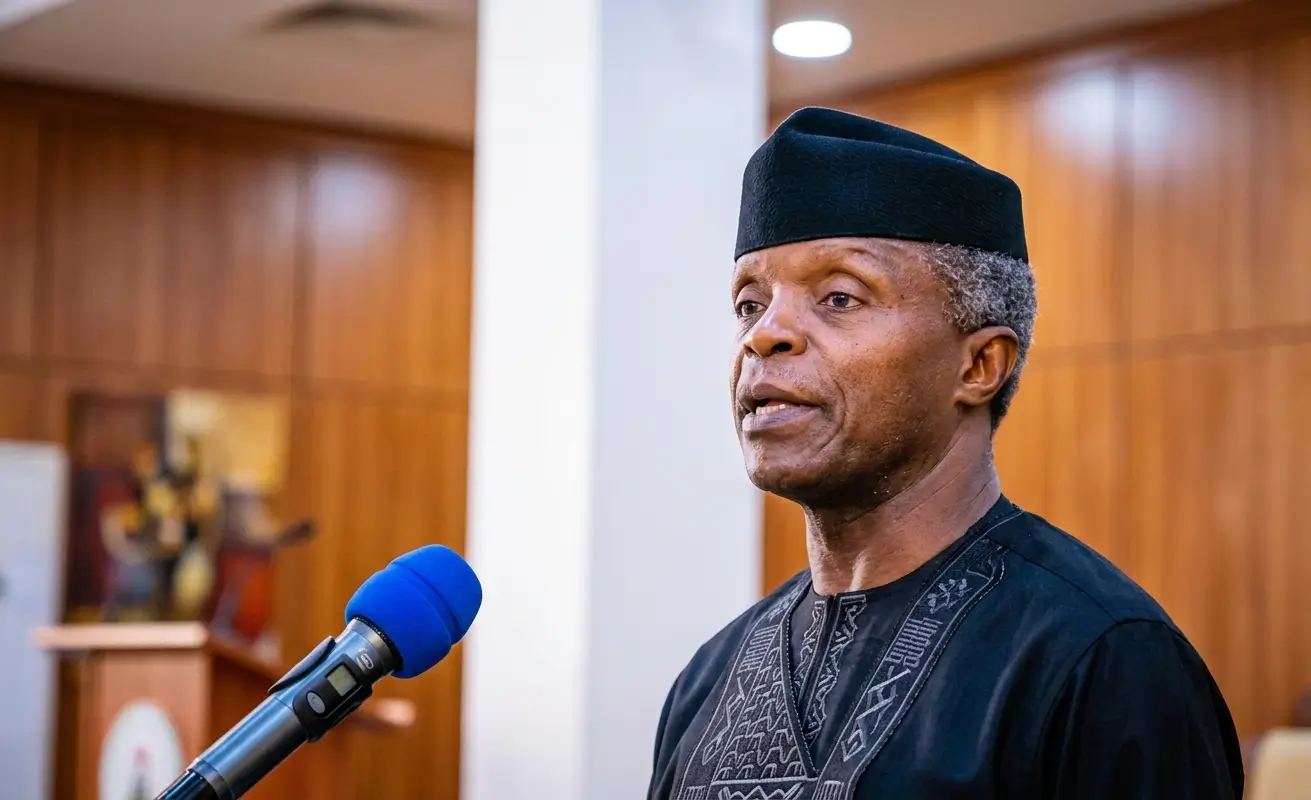
Former Vice-President Yemi Osinbajo says Nigeria cannot close its university access gap by relying mainly on conventional campuses, urging wider adoption of open and distance learning.
Osinbajo made the call on Tuesday at the fifth International Colloquium of the Distance Learning Institute of the University of Lagos, held in Lagos
The colloquium, chaired by Osinbajo, was themed, “Reimagining the Open Distance Learning Ecosystem: Technology, Policy and Institutional Priorities.”




The former Vice-President said more than 2.2 million Nigerians seek admission into tertiary institutions annually, putting enormous pressure on a university system whose physical capacity remains limited.
“The mathematics of access to university education in Nigeria simply does not work if we continue to rely mainly on conventional campus models for university education,” he said.
According to Osinbajo, the country cannot build lecture theatres, laboratories, hostels and other facilities quickly enough to match the projected growth in demand.
He therefore argued that open and distance learning should no longer be treated as a peripheral alternative to conventional university education.
“This is why open and distance learning can no longer be seen as something on the margins of higher education. It is now clearly a national necessity,” he said.
Osinbajo identified artificial intelligence as one of the technologies capable of transforming the sector, saying AI could help universities provide personalised learning to large numbers of students.
He said AI-powered systems could explain concepts, test students’ understanding, translate learning materials and provide feedback based on individual learning needs.
But he cautioned universities against mistaking the digitisation of existing practices for genuine educational transformation.
“All we do is take our lecture, put it on Zoom, upload a PDF, and call that transformation,” he said.
The former Vice-President said universities needed to rethink how students learn and how academic performance is assessed rather than simply transferring classroom teaching to the internet.
He also said distance education should serve workers and professionals who need to continuously acquire new skills as technology changes the nature of employment in sectors ranging from banking and accounting to law and engineering.
Osinbajo, however, warned that the expansion of digital education would remain difficult without tackling unreliable electricity, expensive internet services and the high cost of digital devices.
He advocated learning platforms that can operate effectively on mobile phones and, where possible, provide offline access.
UNILAG Vice-Chancellor, Prof. Folasade Ogunsola, agreed that Nigeria’s traditional university model was under growing pressure from the country’s youthful population.
Ogunsola said open and distance learning should not be viewed as an inferior form of higher education, stressing that the quality and recognition of qualifications should be the focus rather than the mode through which students study.
She said UNILAG does not indicate distance learning on its certificates, reflecting the university’s policy of applying the same quality standards to its distance and conventional programmes.
According to her, the next phase of ODL development should move from distance learning to connected learning, from content delivery to deeper engagement, and from increasing enrolment to improving learning outcomes and employability.
Ogunsola also highlighted the potential of AI to support personalised learning, immediate feedback, content development, assessment and early identification of students who may be struggling.
She warned, however, that universities must confront academic integrity, data privacy, intellectual property, algorithmic bias and digital inequality as technology becomes more deeply embedded in education.
The Vice-Chancellor called for policies covering online assessment, digital credentials, AI in education, micro-credentials, credit transfers, recognition of prior learning and quality assurance.
Director of UNILAG’s Distance Learning Institute, Prof. Risikat Dauda, said stakeholders must ensure that the recommendations emerging from the colloquium lead to concrete institutional strategies, regulatory guidelines and national policies.
With Nigeria facing persistent pressure on tertiary education capacity, the discussions at UNILAG have renewed the debate over whether flexible and technology-driven education can become a mainstream solution to the country’s university access challenge.