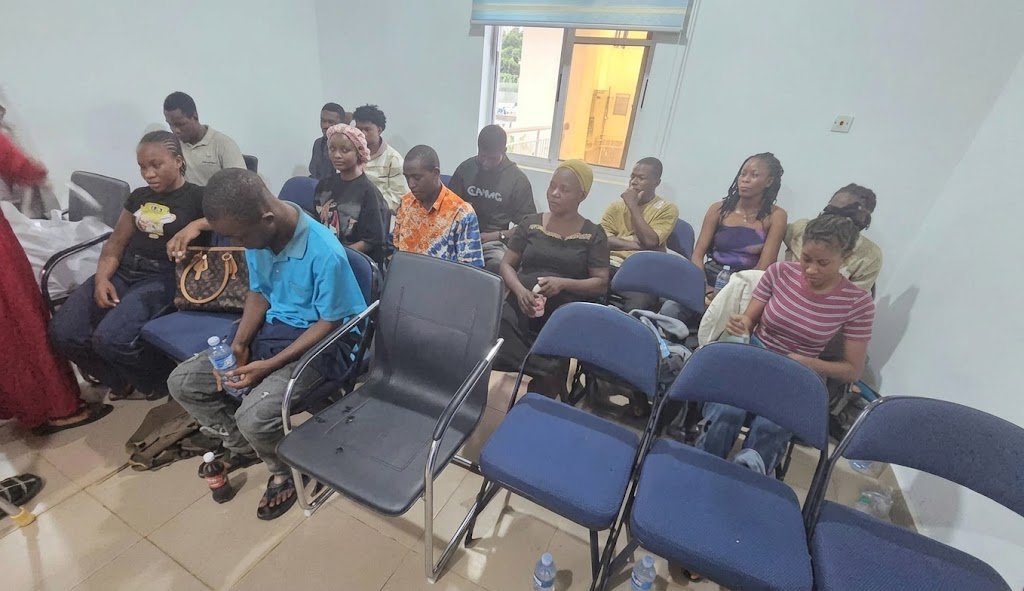
The 20 prospective members of the National Youth Service Corps (NYSC) abducted in Imo State have reportedly been offered the option of choosing any of the six South-West states for their national service following their release.
A parent of one of the survivors said the graduates had been allowed to select their preferred states and continue their service with the current batch.
“They have been given the opportunity to choose states in the South-West to continue their service with the current batch,” the parent said.




However, the NYSC had yet to officially confirm the reported posting arrangement as of the time of the initial report.
The development comes amid revelations that families of the abducted graduates paid ₦6m per captive to secure their release, despite the police maintaining that sustained security operations forced the kidnappers to free them.
A parent who spoke anonymously said the families eventually paid the ransom but waited until the victims were released before disclosing the payment.
A relative of another survivor, identified as Joy Zainab, also confirmed that family members and well-wishers contributed towards the money.
She expressed gratitude to those who prayed for the victims, shared their stories and provided financial assistance during the ordeal.
The disclosures corroborated an earlier account by Alirat Wahab, the mother of another victim, who said the kidnappers initially demanded ₦50m per captive.
In an interview with News Central Television, Wahab said the abductors later reduced their demand to ₦15m before eventually agreeing to accept ₦6m following appeals from the family.
She said the family initially pleaded with the kidnappers to accept ₦500,000 but could not reach an agreement at that amount.
According to Wahab, relatives and well-meaning Nigerians contributed to raise the ransom.
She also explained that the kidnappers directed the families to send representatives to Ibadan, Oyo State, where her husband and son met an intermediary.
The money was subsequently transferred into a designated account, while the representatives were reportedly instructed to convert the funds into US dollars upon arrival in Imo State.

The 20 prospective corps members were abducted on October 1 along the Owerri-Onitsha Road, near Umunoha in the Mbaitoli Local Government Area of Imo State.
They were travelling in two commercial buses operated by Uko Akwa Ibom Motors and were reportedly heading towards Abia and Akwa Ibom states for their national service.
The police announced on Wednesday that the graduates had been rescued at Amakohia Ubi Village in the Owerri West Local Government Area of Imo State.
However, the families disputed the official account of their release, insisting that ransom payments were made.
Imo State Commissioner of Police Audu Bosso said he was unaware of any ransom payment, maintaining that sustained security pressure forced the abductors to release the victims.
The Force Public Relations Officer, CSP Anietie Iniedu, also said the graduates were rescued through joint search-and-rescue operations involving security agencies.
The police said the survivors were taken to the Department of State Services hospital in Owerri for medical evaluation.
The NYSC Director-General, Brigadier General Olakunle Nafiu, visited the graduates alongside the police commissioner and the commander of the 34 Artillery Brigade.
The incident has renewed concerns about the safety of prospective corps members travelling long distances to orientation camps.
It has also intensified debate over the future of the NYSC scheme, established in 1973 to promote national unity and integration by deploying graduates to states outside their states of origin.
In June 2026, the Federal Executive Council approved reforms aimed at improving the scheme, including risk-sensitive deployment, a technology-driven call-up process and an extension of the orientation programme from three to six weeks.
The reforms have drawn renewed attention following the abduction, with questions emerging about how security measures will protect graduates travelling to camps and those posted to areas facing security threats.
For the freed graduates and their families, the immediate concern is recovery from the ordeal and the safe continuation of their national service.