



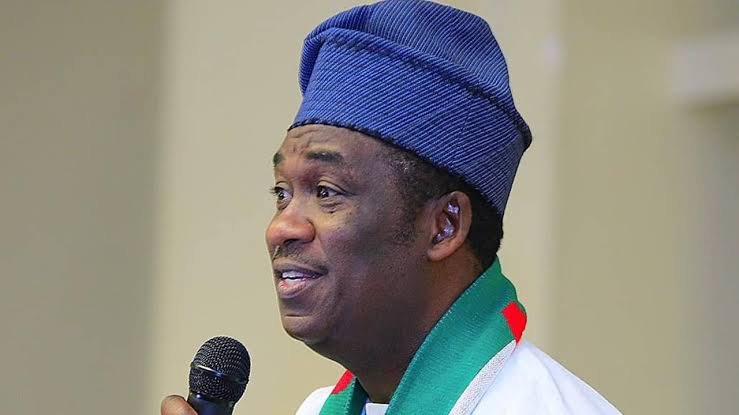
Lagos State Deputy Governor Obafemi Hamzat has clarified his controversial description of traffic congestion in the state as a “lifestyle”, saying the remark was made in the context of storytelling and podcast consumption.
Hamzat addressed the controversy in a video shared on Sunday by Wale Ajetunmobi, Senior Special Assistant to Governor Babajide Sanwo-Olu on Media, after his comments at PodFest Naija 2026 triggered criticism on social media.
Speaking at the September 25 event in Lagos, Hamzat had linked the city’s long commuting hours to the creative industry, saying residents often consume podcasts and other digital content while travelling through congested roads.




Reports of the speech quoted him as saying traffic was “not a problem” but “just a lifestyle”.
In his clarification, however, Hamzat read from the wider passage of his speech and said his point was that traffic had become part of the daily experience of Lagos residents.
“Anyone who has crossed Third Mainland Bridge at 6pm going from VI to Mainland knows that Lagos traffic is not just a problem, it is becoming our lifestyle,” he quoted himself as saying.
He said the statement was intended to explain how commuters spend their time and consume creative content while travelling, rather than comment on road design or suggest that congestion should be accepted as a desirable condition.
Hamzat questioned the interpretation of his comments alongside criticisms from tech entrepreneur Tayo Oviosu and former Lagos governorship candidate Gbadebo Rhodes-Vivour.
He cited Oviosu’s argument that Lagos traffic was caused by poor road design rather than economic activity, as well as Rhodes-Vivour’s criticism that congestion should not be treated as a lifestyle and was damaging productivity.
“That’s what I said. Now, how people correlate that to say design is incredible. Really incredible,” Hamzat said.
He also criticised what he described as selective interpretation of statements on social media.
“So it seems to me that when people go on social media, they don’t read what people say. And that’s the problem,” he said.
Hamzat’s original comments were made during a keynote address focused largely on creativity, technology, culture and the future of Lagos.

He said the city’s traffic had, in an unexpected way, become an audience generator for the podcast industry because residents use long journeys to consume episodes.
The deputy governor also urged podcasters and other creatives to develop sustainable business models, arguing that a large audience alone was not enough to guarantee commercial success.
The controversy has nevertheless shifted attention from the creative-industry focus of his speech to Lagos’ longstanding congestion problem.
Defending Hamzat, Olusesan Daini, Director of the New Media Directorate of the joint PBAT-KOH Lagos State Campaign Council, said the deputy governor’s words had been presented without their broader context.
Daini said acknowledging that traffic had become part of everyday life was different from accepting congestion as the desired state of Lagos.
He pointed to government investments in rail and water transport, road construction, junction improvements, intelligent traffic management systems and LASTMA operations.
The clarification leaves two issues at the centre of the debate: what Hamzat intended to convey about the relationship between traffic and content consumption, and the wider question of how effectively Lagos is addressing persistent congestion.
His explanation comes as the “lifestyle” phrase continues to generate discussion over Lagos’ transport challenges and the language used by public officials when discussing them.