




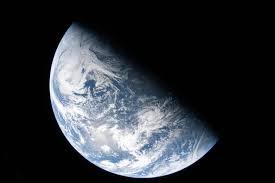
NASA has released the first high-resolution Artemis II Earth images, offering a breathtaking view of the planet as astronauts aboard the Orion spacecraft begin their historic journey toward the Moon.
The photographs, taken shortly after a critical engine burn pushed Orion out of Earth’s orbit, mark the first crewed images sent back from beyond low Earth orbit in more than five decades. The mission is the first time humans have travelled toward the Moon since Apollo 17 Moon Landing in 1972.
Mission commander Reid Wiseman captured the images moments after Orion completed its trans-lunar injection burn, the decisive manoeuvre that placed the spacecraft on its outbound path to the Moon.




One of the most striking photographs, titled “Hello, World,” shows Earth in vivid detail from deep space. The Atlantic Ocean appears in a rich, glassy blue, bordered by a faint atmospheric glow, while shimmering green auroras swirl above both polar regions.
From the crew’s perspective, the planet appears inverted, with parts of Africa, Europe and South America clearly visible through the capsule window.
NASA said the images were taken just after the nearly six-minute engine firing that successfully sent Orion beyond Earth orbit and onto a looping trajectory around the far side of the Moon.

The spacecraft is expected to make its closest pass of the Moon on April 6 before beginning its return leg to Earth, with splashdown scheduled for April 10 in the Pacific Ocean off the coast of San Diego.
The Artemis II mission carries four astronauts — three from NASA and one from the Canadian Space Agency — making it the first crewed lunar mission in more than 50 years.
The crew includes Wiseman, pilot Victor Glover, mission specialist Christina Koch, and Jeremy Hansen, who is making history as the first Canadian astronaut to take part in a lunar mission.
NASA also published additional views from inside the Orion capsule.
In one image, the line dividing night and day — known as the terminator — cuts sharply across Earth, creating a dramatic contrast between illuminated clouds and the darkness of the planet’s night side.
Another photograph captures the glow of human civilisation, with city lights visible across large sections of the surface while sunlight brightens the lower edge of the planet.
Although many people in the United States were heading to bed on the night of April 2, the astronauts were simultaneously completing the burn that officially set humanity on course for its first crewed lunar flyby since the Apollo era.
The images have quickly drawn widespread attention online, not only for their visual beauty but for the historic significance of the moment.
For NASA, the release marks another milestone in the Artemis programme, which is intended to pave the way for future lunar landings and, eventually, human missions to Mars.