




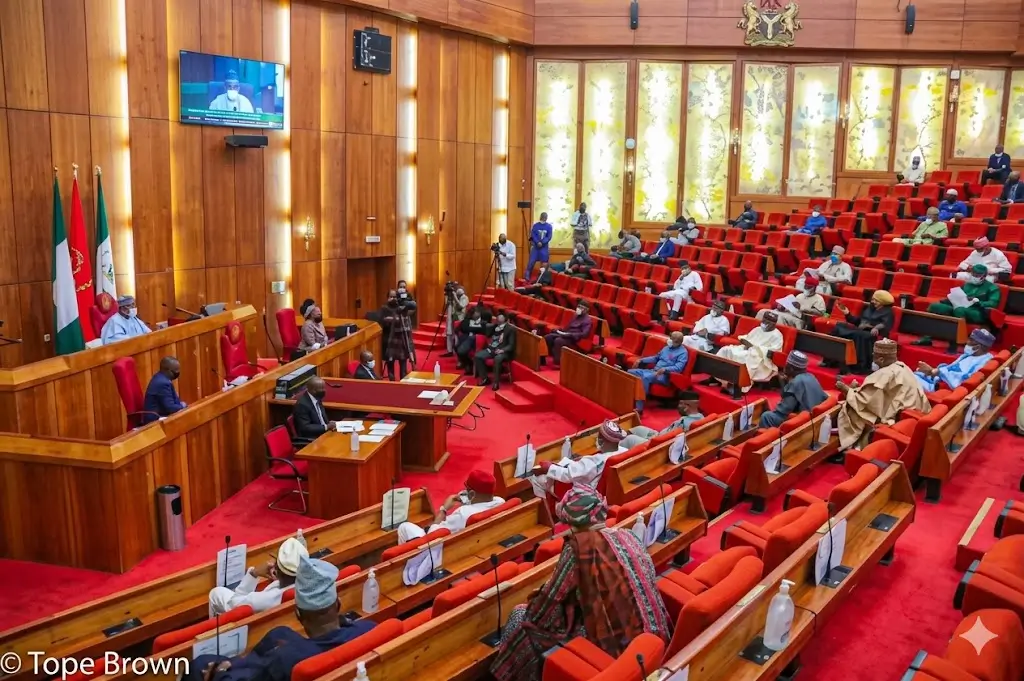
The Senate on Thursday advanced one of Nigeria’s most debated constitutional reform proposals after a bill seeking the establishment of state police successfully scaled second reading, signaling growing legislative support for the decentralisation of policing powers across the federation.
The proposed legislation, which seeks to create state-controlled police formations alongside the Nigeria Police Force, was subsequently referred to the Senate Ad-hoc Committee on the Review of the 1999 Constitution for further scrutiny.
Leading debate on the bill, Senate Leader Senator Opeyemi Bamidele described the proposal as a critical response to Nigeria’s worsening security crisis, arguing that the current centralised policing structure has struggled to address increasingly localised threats across different parts of the country.




According to Bamidele, Nigeria continues to face a complex range of security challenges, including terrorism, banditry, mass kidnappings, farmer-herder clashes, cult-related violence, armed robbery, pipeline vandalism, communal conflicts and cybercrime.
“The establishment of state police will improve intelligence gathering. Local police officers are better equipped to obtain actionable intelligence from communities because they understand local languages, customs and social structures,” he told lawmakers.
He argued that modern policing relies heavily on intelligence and local knowledge, stressing that decentralised policing would strengthen early-warning systems and improve response times during emergencies.
The bill proposes significant constitutional changes, including transferring policing from the Exclusive Legislative List to the Concurrent Legislative List. It also seeks to establish State Police Service Commissions, define the responsibilities of federal and state police formations, and create oversight mechanisms to regulate their operations.
Bamidele insisted the proposal would not undermine national unity but rather strengthen Nigeria’s federal structure.

One of the longstanding criticisms of state police is the fear that governors could weaponise security agencies against political opponents. Addressing those concerns, he said the bill contains several safeguards designed to prevent abuse.
Among the protections highlighted are federal oversight through the Federal Police Service Commission, legislative confirmation of senior appointments, uniform national policing standards, periodic operational reviews and constitutional procedures governing the removal of state commissioners of police.
The bill also provides for federal intervention in situations where law and order completely breaks down within any state.
Bamidele pointed to federal systems such as the United States, Canada, Australia and Germany, where federal and sub-national policing structures coexist, arguing that Nigeria should not remain an exception among federations.
The proposal received broad support during debate, particularly from senators representing northern states, many of whom argued that decentralised policing could offer a more effective response to insecurity affecting communities across the country.
Senate Chief Whip Tahir Monguno backed the bill, saying it would provide a legal framework for regulating the growing number of vigilante and community security groups operating nationwide.
The debate comes at a time when calls for state police have intensified amid persistent attacks by bandits, terrorists and criminal gangs in several regions.
Supporters argue that officers recruited from local communities would possess a better understanding of terrain, language and social dynamics, making them more effective in preventing and responding to crime.
The proposal remains one of the most consequential constitutional amendments currently before the National Assembly. If eventually approved by both chambers and ratified by state Houses of Assembly, it could fundamentally reshape Nigeria’s security architecture and redefine policing responsibilities between the federal and state governments.