


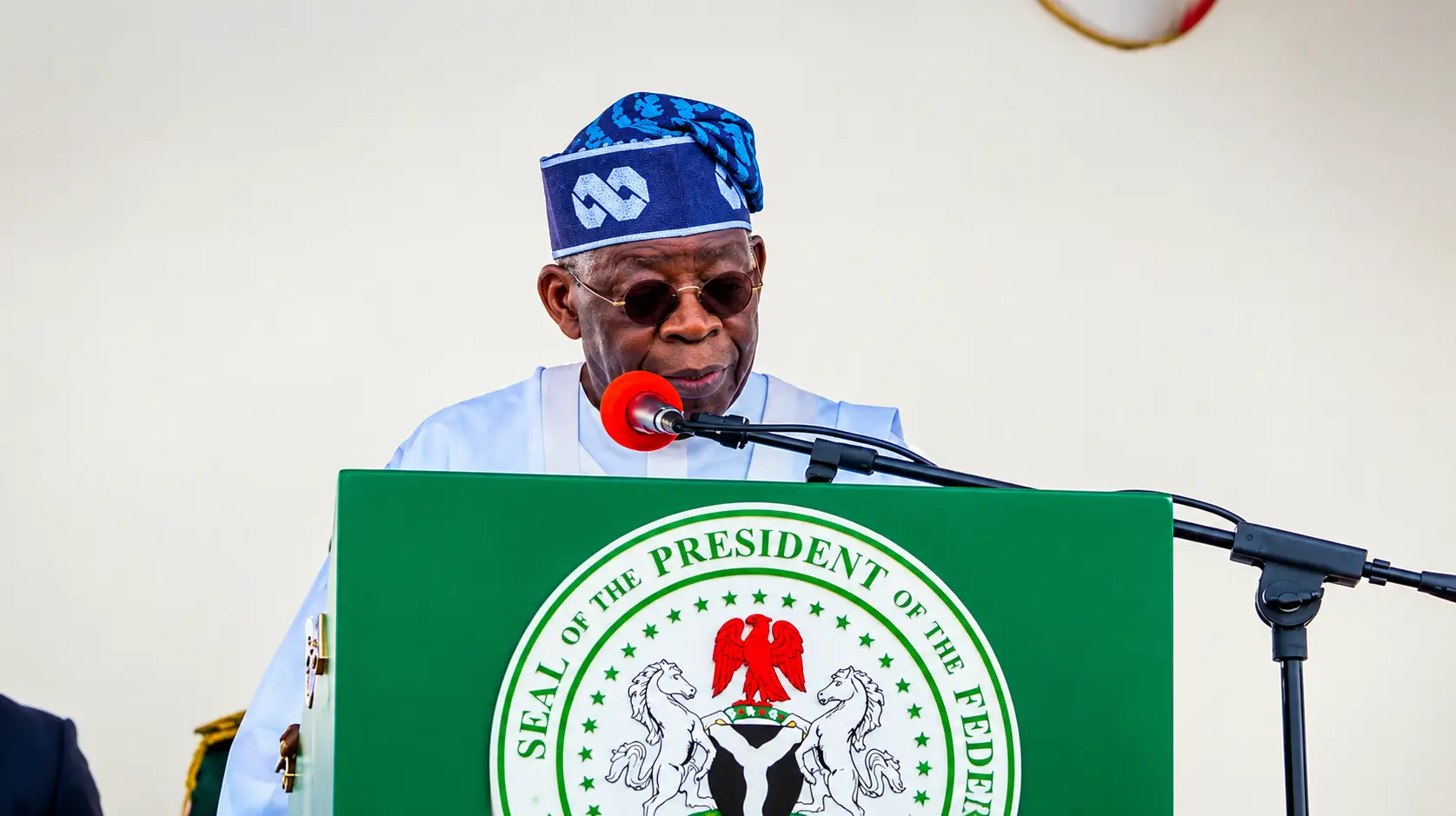
President Bola Tinubu has declared that Nigeria has moved beyond the most difficult phase of his economic reforms and entered what he described as an “age of prosperity”, shifting the focus of his administration towards jobs, lower living costs, production and wider opportunities.
Tinubu made the declaration in his Independence Day address on Thursday, October 1, 2026, as Nigeria marked its 66th anniversary.
The speech, titled “From Reform to Prosperity”, was delivered against the backdrop of continued concerns over household purchasing power and growing political debate ahead of the 2027 elections.



The President defended the removal of petrol subsidy and the foreign-exchange reforms introduced under his administration, comparing Nigeria’s economic situation to a cancer patient who had to undergo painful treatment rather than rely on temporary relief.
“For too long, Nigeria’s leaders chose morphine while praying for a miracle that never came,” Tinubu said.
He argued that his reforms had confronted, rather than created, longstanding weaknesses in the Nigerian economy.

A major political element of the address was his rejection of renewed calls for petrol subsidies.
Tinubu warned Nigerians against what he called the “siren song” of returning to subsidy payments, an apparent reference to opposition proposals ahead of 2027.
Former Vice-President and African Democratic Congress presidential candidate, Atiku Abubakar, has repeatedly said he would restore a targeted petrol subsidy if elected.
Tinubu said the economy had grown by more than four per cent in 2026, with both oil and non-oil sectors contributing to what he described as a period of stable growth.
The latest National Bureau of Statistics data show that Nigeria’s real GDP expanded by 4.43 per cent year-on-year in the second quarter of 2026, compared with 3.89 per cent in the first quarter.
The President also pointed to lower inflation, improved foreign-exchange stability and stronger non-oil exports as evidence of progress.
Headline inflation stood at 15.39 per cent in August, according to the NBS, although food inflation remained at 19.57 per cent, underlining the pressure still facing households.
Tinubu said the next phase of his administration would focus less on economic stabilisation and more on translating growth into better living conditions.
“The emergency treatment is over. The foundation has been repaired,” he said. “Now, our purpose is simple: shared and widespread prosperity.”
He identified lower production and transportation costs as central to tackling the cost-of-living crisis.
The President promised expanded mechanised irrigation and dry-season farming, better access to seeds and fertiliser, improved agricultural mechanisation, storage facilities and investment in roads, railways and ports.
According to Tinubu, reducing the cost of producing and moving goods would eventually translate into lower prices for consumers.
On employment, he said jobs, enterprise and industrial growth would become central to government policy.
Tinubu pledged to use Nigeria’s gas resources to support industries, revive factories, expand digital connectivity and develop skills required by employers.
“I want to see more Nigerians making things,” he said. “I want to see more Nigerian farms feeding our cities and supplying our factories.”
The President acknowledged that millions of Nigerians were still struggling with food, school fees, healthcare and transportation.
He said programmes including the Nigerian Education Loan Fund, CREDICORP and social assistance schemes were designed to provide support while the wider economy generates more productive opportunities.
“These programmes are not substitutes for prosperity. They are a bridge,” Tinubu said.
He also acknowledged that the government could not reverse decades of economic and institutional problems within four years but argued that it could change the country’s direction.
“It will take time. It will require discipline. It will require sustained growth year after year and the creation of millions of productive opportunities across our country,” he said.
Tinubu ended the address with a biblical metaphor, declaring that Nigeria had “passed through our own Red Sea” and urging Nigerians not to look back.
“The age of reform has done its work. Now begins the age of prosperity,” he said.