



The widening disagreement between Minister of the Federal Capital Territory, Nyesom Wike, and governors elected on the platform of the All Progressives Congress has become one of the latest political flashpoints ahead of the 2027 general election.
In a column published on Sunday, journalist and political commentator Festus Adedayo used Yoruba proverbs and extended metaphors to examine the dispute, arguing that the confrontation exposes deeper tensions over political structures and influence ahead of the elections.
The immediate trigger was the decision by the Progressive Governors Forum, chaired by Imo State Governor Hope Uzodimma, to reject participation in political alliances outside the APC structure.




Following a meeting in Abuja on September 14, the governors said they would not participate in, support or endorse any arrangement capable of weakening the APC or adversely affecting its candidates at any level in 2027.
The position was widely interpreted as a response to Wike’s Rainbow Coalition, which the minister has been promoting as a platform to mobilise support for President Bola Tinubu’s re-election.
Wike, however, has rejected the suggestion that he sought an alliance with APC governors.
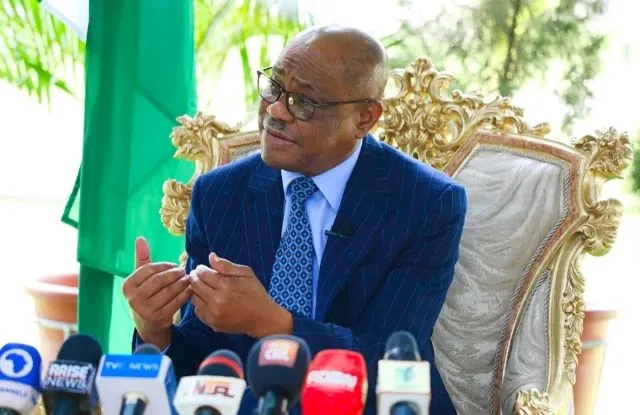
In an interview with ARISE News, he said he had never approached the governors for a Rainbow Coalition arrangement and criticised their position as politically lazy and baseless.
He has also maintained that the coalition’s objective is to support Tinubu’s re-election rather than all APC candidates in the 2027 elections.
That distinction lies at the heart of the dispute.
The APC governors have maintained that their campaign efforts will support the party’s candidates at all levels, while Wike has argued that support for Tinubu does not automatically translate into support for every APC candidate.
Adedayo’s column interprets the disagreement as evidence of a deeper struggle over influence and party control.
Using the Yoruba saying, “Ìjà níí gb’ẹyìn àlè” — translated as “fights are always the end of adulterous flings” — the writer frames the dispute as the latest manifestation of contradictions within the political relationship involving Wike and the APC-led federal administration.
The column also revisits Wike’s political history. The former Rivers State governor was a leading member of the Peoples Democratic Party before his appointment as FCT minister by President Tinubu in 2023.
Wike has remained associated with the PDP while serving in an APC-led federal administration, an arrangement that has produced an unusual political alignment ahead of the 2027 elections.
The current disagreement has produced increasingly direct exchanges. Wike criticised Uzodimma and Kwara State Governor AbdulRahman AbdulRazaq over their opposition to his political activities, while APC figures have defended the governors and questioned the minister’s approach.
The dispute has also drawn reactions from other sections of the APC. Party leaders in the South-East backed the Progressive Governors Forum and rejected the Rainbow Coalition, insisting that APC structures should support the party’s candidates in the 2027 elections.
For Adedayo, the exchanges point to the difficulty of maintaining a political arrangement in which Wike can support Tinubu’s presidential bid while remaining outside the APC’s formal structure and retaining freedom to oppose or support candidates in other contests.
The dispute is therefore no longer limited to personal exchanges between political actors. It has developed into a broader argument over party loyalty, campaign structures and the boundaries of political alliances ahead of 2027.
How the disagreement is ultimately managed could have implications for the relationship between Wike, the APC’s leadership and governors as political mobilisation intensifies across the country.