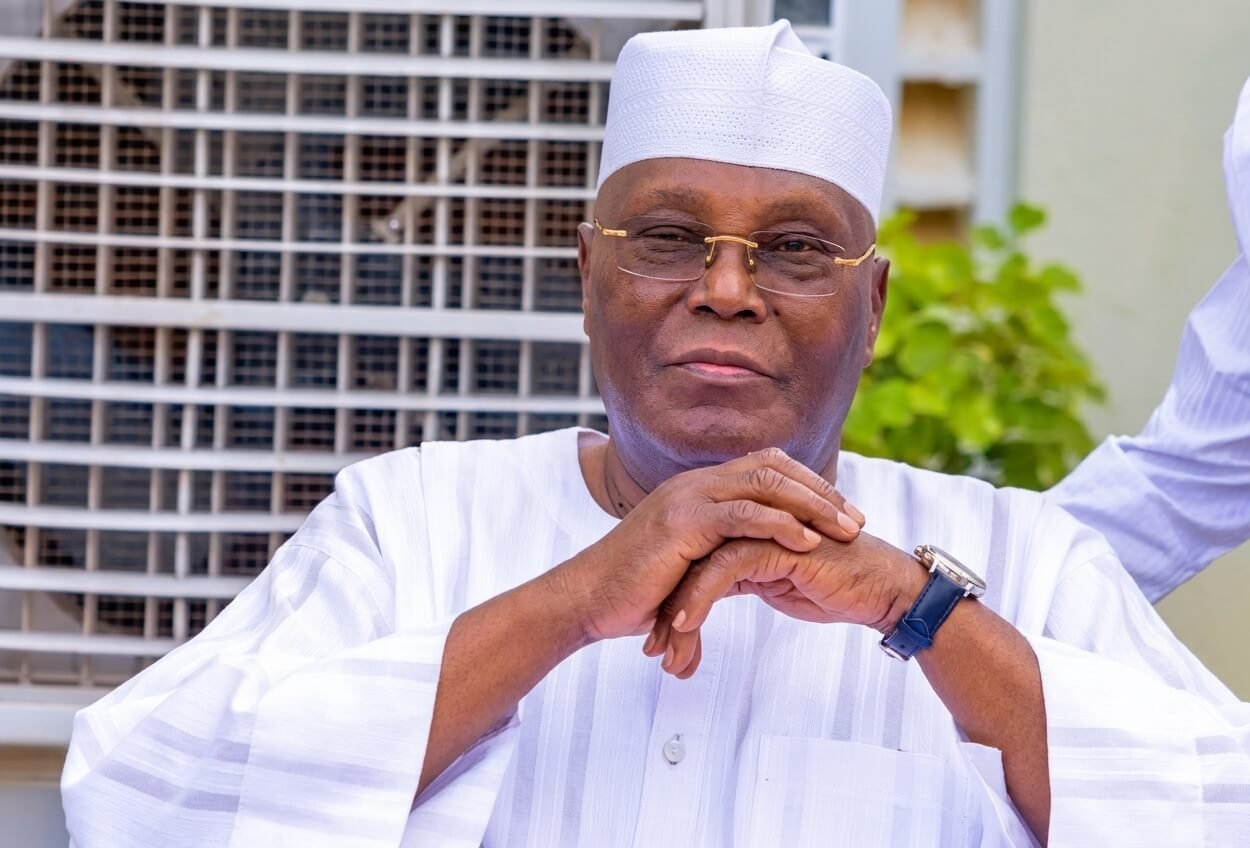
The African Democratic Congress Presidential Campaign Council has described former Vice President Atiku Abubakar as a pan-Nigerian leader, arguing that his relationships across ethnic, religious and regional boundaries make him better suited to unite the country ahead of the 2027 presidential election.
The council’s Director of Media and Publicity, Kola Ologbondiyan, made the declaration on Saturday while receiving the leadership of the Grassroots Mobilisation Network, led by its National Coordinator, Sadiq Abubakar Adamu Lwafu, during a visit to his office.
Ologbondiyan said Atiku’s family, business and political associations reflected Nigeria’s diversity and demonstrated his capacity to work with people from different backgrounds.

“Atiku Abubakar, on the other hand, is a natural Nigerian devoid of ethnic, religious or sectional inclination. He is a leader for all tribes and regions,” he said.
He maintained that the former vice president’s connections across the country distinguished him from politicians he accused of exploiting ethnic and religious differences for electoral advantage.
Ologbondiyan also accused President Bola Tinubu’s administration of sectionalism, alleging that its appointments, policies and governing approach had encouraged exclusion rather than national cohesion.

“In the last three years, Tinubu has shown clannishness in governance. His appointments, his policies, his body language—everything screams sectionalism and exclusion,” he alleged.
He further accused the ruling All Progressives Congress of capitalising on the country’s divisions to retain political power, arguing that the government had not delivered sufficient improvements in living conditions to justify its approach.
The allegations represent the campaign council’s political assessment and were not accompanied in the statement by a detailed comparative analysis of federal appointments or policies.
Ologbondiyan argued that Nigeria needed a leader with the experience and policy proposals to address its economic difficulties. He described Atiku’s record as evidence that the former vice president could provide an alternative direction for the country.
On fuel subsidy, the campaign council director said an Atiku administration would restore the policy under what he described as a transparent and properly managed arrangement intended to protect vulnerable Nigerians and support production.
“Atiku is going to bring back subsidy in a transparent and well-managed manner that will directly benefit the poor and stimulate production,” he said.
The statement did not provide detailed figures on the proposed subsidy framework, its funding arrangements or how the benefits would reach intended recipients.
Atiku’s position on subsidy has become part of the economic debate ahead of the election. His campaign’s proposal to restore subsidy has drawn public discussion over how such a policy would be funded and implemented.
Lwafu said the Grassroots Mobilisation Network was preparing a nationwide campaign to build support for Atiku and challenge the APC at the ballot box in 2027.
He criticised the Tinubu administration over what he described as worsening economic hardship, insecurity and the weakening of democratic institutions.
“President Tinubu’s administration has made life so difficult for Nigerians. The hardship is too much. Nigerians are now living in fear of insecurity,” Lwafu said.
He also warned that Nigeria risked following the path of countries where democratic institutions had weakened and political power had become increasingly concentrated.
Lwafu described the ADC as a platform bringing together experienced politicians and people committed to national development. Among the figures he cited were former Senate President David Mark, former Rivers State governor Rotimi Amaechi, former Osun State governor Rauf Aregbesola, former Sokoto State governor Aminu Tambuwal, former Imo State governor Emeka Ihedioha and media entrepreneur Dele Momodu.
The ADC announced Amaechi as Atiku’s running mate in June and subsequently said it had submitted both candidates’ particulars to the Independent National Electoral Commission. However, a rival ADC faction has disputed the party leadership’s position on the presidential ticket, making the party’s internal dispute an important consideration in coverage of its preparations for the election.
The presidential and National Assembly elections are scheduled for January 16, 2027.
Ologbondiyan commended the mobilisation group and said the campaign council would continue working with grassroots organisations seeking political change, national unity and improved governance.